



 Tracey Beatrice
 India’s decision to boycott trade and travel with Turkey and Azerbaijan has become a flashpoint in South Asia’s evolving geopolitical landscape. This move, prompted by Ankara and Baku’s open support for Pakistan in the wake of the Pahalgam terror attack and India’s subsequent Operation Sindoor, is not simply a matter of diplomatic tit-for-tat. It is a principled stand against the normalisation of state-sponsored terrorism and a message to the world that economic interests cannot override national security and moral responsibility. Here’s a comprehensive analysis of why India’s boycott is justified, the context behind it, and what it means for the broader fight against terrorism.
The Immediate Trigger: Turkey and Azerbaijan’s Pro-Pakistan Stance
The current tensions began after the devastating terror attack in Pahalgam, Kashmir, on 22 April 2025, which claimed 26 innocent lives. India responded with Operation Sindoor, targeting and destroying nine terror camps in Pakistan and Pakistan-occupied Kashmir. Instead of condemning the terror attack or supporting India’s right to self-defence, both Turkey and Azerbaijan issued statements criticising India’s actions and voicing support for Pakistan.
- Turkey’s Response: The Turkish Foreign Ministry labelled India’s airstrikes as “provocative” and warned of the risk of escalation, while Turkish-made drones were found to have been used by Pakistan in attempted attacks on Indian military installations.
- Azerbaijan’s Position: Azerbaijan’s government criticised India’s military operation, raised concerns about civilian casualties, and called for a diplomatic solution, effectively equating India’s counter-terror response with Pakistan’s long history of sponsoring cross-border terrorism.
This alignment with Pakistan, a country globally recognised for its support of terror groups, was seen in India as a direct affront to its sovereignty and security, sparking nationwide calls for a boycott of Turkish and Azerbaijani goods and travel.
The Boycott: A Grassroots and Institutional Response
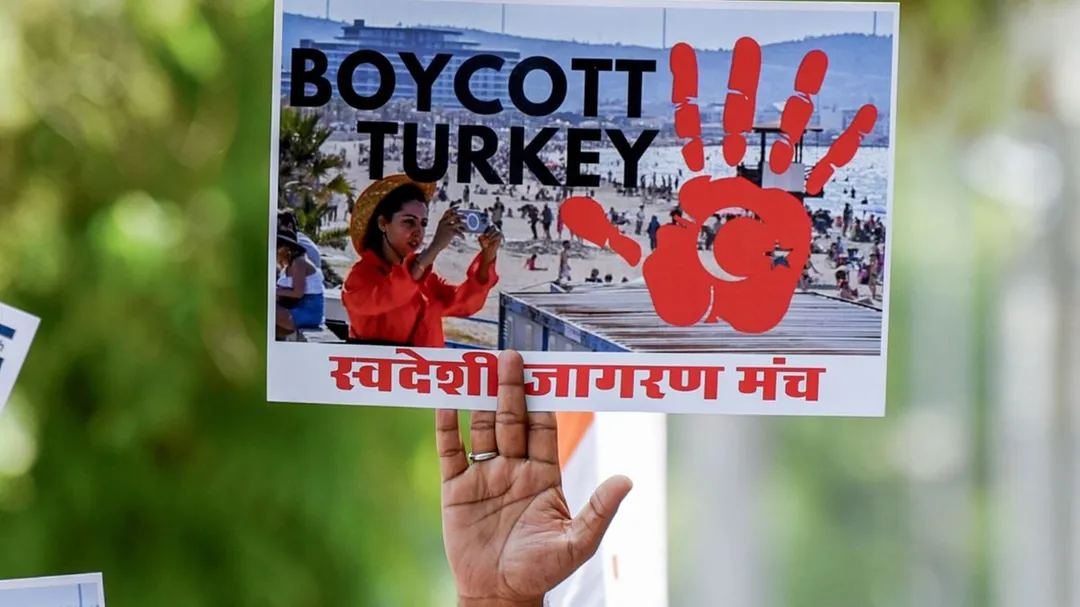
The response in India has been both spontaneous and organised. Major trade associations, including the Confederation of All India Traders (CAIT), representing 80 million traders and over 40,000 trade associations, have declared a complete boycott of Turkish and Azerbaijani products. The Azadpur Mandi, Asia’s largest fruit and vegetable wholesale market, has stopped importing Turkish apples. Indian companies have been urged not to shoot advertisements or films in Turkey and Azerbaijan, with a warning that any company doing so will also face a boycott.
Travel platforms such as EaseMyTrip and Ixigo have issued advisories against visiting Turkey and Azerbaijan, while MakeMyTrip has discontinued all promotions and offers for travel to these countries. The boycott extends beyond trade to tourism and cultural exchanges, reflecting deep offence to national sentiment and a unified resolve to send a strong message.
The Case Against Turkey and Azerbaijan: Enabling Terrorism by Proxy
1. Supporting a State Sponsor of Terrorism
Pakistan’s record as a state sponsor of terrorism is well-documented. Its intelligence agencies have long funded, trained, and armed groups such as Lashkar-e-Taiba, Jaish-e-Mohammed, and the Taliban, responsible for thousands of deaths in India, Afghanistan, and beyond. Even former Pakistani leaders have admitted the state’s role in nurturing terror groups for strategic depth and leverage.
By siding with Pakistan in the aftermath of a terror attack, Turkey and Azerbaijan are not merely expressing diplomatic solidarity; they are, in effect, enabling the narrative that terrorism can be justified or overlooked for geopolitical gain. This is not just an affront to India but to the global fight against terrorism.
2. Undermining International Norms
The global consensus, embodied in UN resolutions and international law, is clear: states must not support, harbour, or justify terrorism. By criticising India’s counter-terror operations and ignoring Pakistan’s role, Turkey and Azerbaijan undermine these norms, emboldening terrorist groups and their sponsors.
3. Weaponising Trade and Technology
Turkey’s provision of military technology, particularly drones, to Pakistan has had direct security implications for India. These drones have been used in attempts to target Indian military installations, escalating the threat level and demonstrating that Ankara’s support goes beyond rhetoric to material assistance.
Economic Impact and Strategic Calculus
1. Trade Figures and Trends
India’s trade with Turkey and Azerbaijan, while not insignificant, is not irreplaceable. In recent years, trade with Turkey has been declining, with exports falling by nearly 15% and imports by over 17% in the last fiscal year. Key imports from Turkey include crude petroleum, gold, aircraft, granite, marble, and apples, while exports include aluminium products, auto components, and telecom instruments. Trade with Azerbaijan is even smaller, with exports at $86 million and imports at less than $2 million.
2. Domestic Alternatives and Global Partnerships
The boycott is unlikely to have a major economic impact on India, given the availability of alternative suppliers for most goods. The move is as much about principle as it is about economics, signalling India’s willingness to absorb short-term costs for long-term security and moral clarity.
3. Strategic Autonomy and Global Messaging
India’s action reinforces its strategic autonomy and willingness to take tough stands, even if it means friction with countries outside the immediate region. It also sets a precedent for other nations grappling with similar dilemmas, showing that economic interests need not trump national security or ethical considerations.
Why the Boycott Is Justified: The Moral and Security Imperative
1. Standing Up to Terrorism
India’s decision is rooted in the principle that terrorism cannot be normalised or excused under any circumstances. By boycotting countries that support or justify Pakistan’s actions, India is drawing a clear line: there can be no business as usual with states that enable terror.
2. Defending Sovereignty and National Honour
Every nation has the right to defend its citizens and territory. When Turkey and Azerbaijan chose to side with Pakistan after a terror attack, they crossed a red line for India. The boycott is a measured, non-military response that asserts India’s sovereignty and signals that respect for its security is non-negotiable.
3. Global Leadership in Counter-Terrorism
India’s stand is not just about bilateral relations; it is a call to the international community to adopt a zero-tolerance approach to terrorism. By taking concrete action, India is showing leadership and encouraging other countries to hold terror sponsors accountable, whether through sanctions, boycotts, or diplomatic isolation.
Broader Implications: Shaping the Regional and Global Order
1. Redefining Alliances and Partnerships
The episode marks a shift in India’s foreign policy, where economic and strategic partnerships will increasingly be conditioned on a country’s stance on terrorism. Nations that wish to do business with India will need to demonstrate a commitment to counter-terrorism and respect for India’s security interests.
2. Strengthening Domestic Consensus
The boycott has united Indian society across political and business lines, reflecting a rare consensus on national security. This unity strengthens India’s hand in international negotiations and signals to adversaries that attempts to divide or pressure India will not succeed.
3. Encouraging Global Accountability
By taking a stand, India is encouraging the global community to move beyond rhetoric and adopt meaningful measures against state sponsors of terrorism. This could include coordinated sanctions, restrictions on technology transfer, and greater scrutiny of financial flows to countries linked to terror activities.
Addressing Criticisms and Misconceptions
Some critics argue that boycotts are ineffective or that they risk escalating tensions. However, India’s approach is targeted, proportionate, and aimed at changing behaviour, not punishing populations. The focus is on government and strategic sectors, not ordinary citizens. Moreover, the boycott is a legitimate tool of foreign policy, especially when diplomatic engagement fails to yield results.
Others suggest that India should prioritise dialogue. However, dialogue cannot be meaningful when one side continues to justify or enable terrorism. The boycott is a signal that India is open to engagement, but only with partners who respect its core interests and international norms.
Summary
India’s boycott of Turkey and Azerbaijan is a justified, principled, and necessary response to their support for Pakistan’s state-sponsored terrorism. It is a stand for national security, international law, and moral clarity in an era where too many countries look the other way for short-term gain. By taking this step, India is not only defending its own interests but also setting a benchmark for the global fight against terrorism. The world would do well to take note: there can be no compromise with terror, and those who enable it must be prepared to face the consequences.