

 Lara Zijl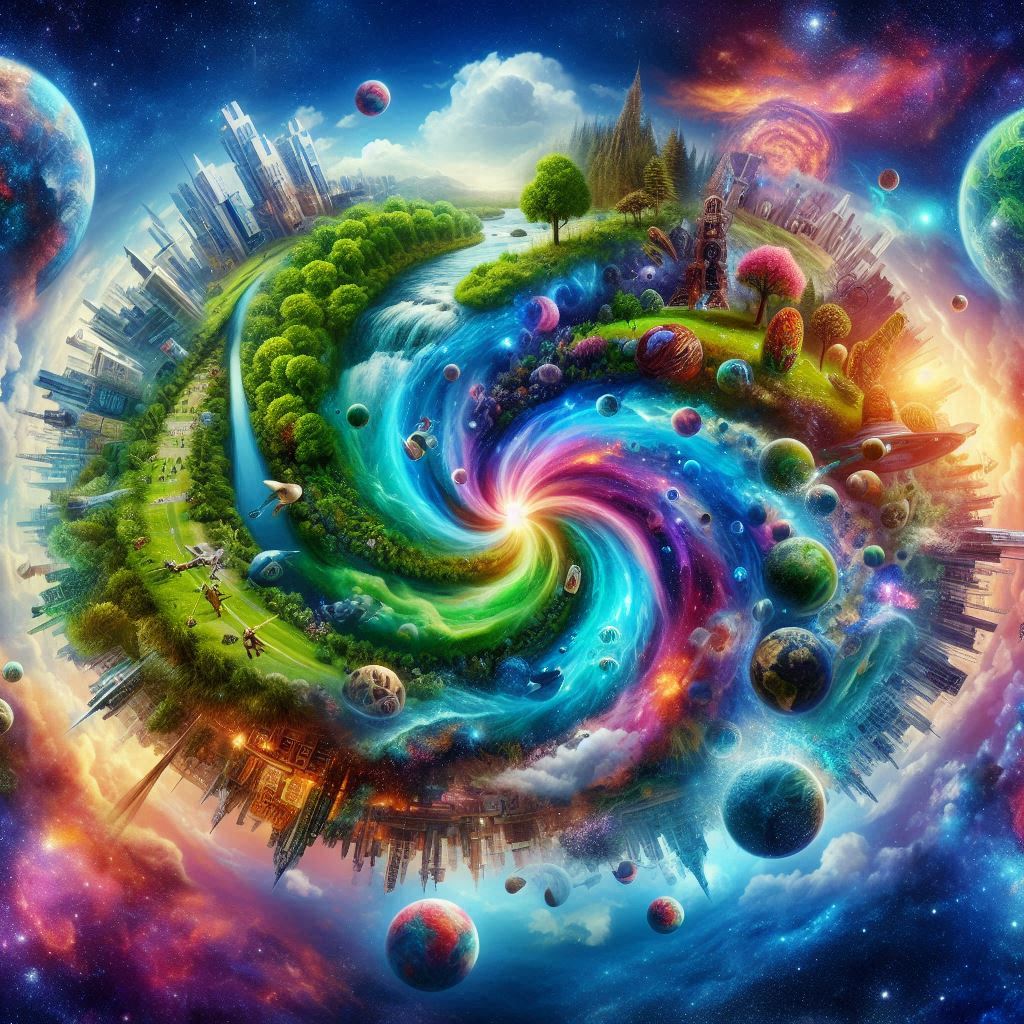
The Bhagavata Purana, a luminous jewel of Hindu literature, stands as one of the most profound and influential texts in the Vaishnava tradition. Composed in Sanskrit and traditionally attributed to Vyasa, it weaves together devotion, philosophy, and cosmology in a tapestry that has inspired centuries of seekers, philosophers, and poets. Yet, beyond its spiritual and literary grandeur, the Bhagavata Purana also presents a cosmological vision that feels uncannily modern-a vision of countless universes, cyclic time, and interconnected realities that mirrors, in many ways, the leading-edge ideas of contemporary science.
In the twenty-first century, when physicists and cosmologists speak of a “multiverse”-a reality where our universe is just one among countless others, each with its own laws and destinies-it is striking to find that such ideas were not only imagined but intricately described in the ancient world. The Bhagavata Purana does not merely hint at the existence of other worlds; it describes them in vivid detail, embedding them in a philosophical framework that unites science, spirituality, and the deepest questions of existence.
This article embarks on a journey through the cosmology of the Bhagavata Purana, exploring its multiversal vision, its philosophical resonance, and its remarkable parallels with modern scientific thought. Along the way, we will encounter legendary episodes, profound metaphors, and a worldview that challenges the very boundaries of what we consider “real.” In doing so, we will discover that the ancient wisdom of India may offer not just poetic inspiration, but genuine insight into the nature of reality itself.
The Bhagavata Purana: A Cosmic Narrative
The Bhagavata Purana is not just a religious scripture; it is a vast, encyclopaedic work that spans twelve cantos and nearly 18,000 verses. Its pages recount the divine exploits (leelas) of Lord Krishna, the supreme Vishnu, as well as the stories of other avatars, sages, and devotees. Yet, woven through these narratives is a rich and complex cosmology-a vision of the universe that is at once mythic, scientific, and deeply philosophical.
At the heart of this cosmology is the concept of the brahmanda-the cosmic egg. According to the Bhagavata Purana, our universe is not unique, nor is it the totality of existence. Rather, it is one among countless brahmandas, each a self-contained cosmos with its own planets, beings, and cycles of time. These universes are born, sustained, and eventually dissolved in the endless dance of creation and destruction, governed by the triad of Brahma (creator), Vishnu (preserver), and Shiva (destroyer).
This vision is not presented as mere allegory. The Purana describes the structure of these universes in detail, outlining their layers, inhabitants, and the laws that govern them. It speaks of time not as a straight line, but as a wheel-cyclic, eternal, and ever-renewing. And it insists, again and again, that all these realities are ultimately united in the supreme consciousness of Vishnu, accessible through both knowledge (jnana) and devotion (bhakti).
Multiple Universes: The Infinite Cosmos
One of the most striking features of the Bhagavata Purana is its insistence on the plurality of universes. Each brahmanda is described as an egg-shaped cosmos, complete with its own Brahma, its own set of planets and realms (lokas), and its own cycles of creation and dissolution. The text goes so far as to say that these universes are as countless as the bubbles that arise on the surface of the ocean, each one emerging from the pores of Maha-Vishnu as he lies in yogic slumber.
This imagery is not merely poetic. The Purana lays out the structure of each universe in detail, describing seven concentric islands and oceans, seven lower realms (patala), and seven higher realms (svarga and beyond). Each universe is enveloped by layers of elemental matter-earth, water, fire, air, ether, mind, intelligence, and ego-each ten times thicker than the last. The sheer scale and multiplicity of these universes is emphasised repeatedly, with the text declaring that even the greatest sages cannot count them all.
Within each brahmanda, time operates according to its own rhythm. The lifespan of Brahma, the creator of each universe, is said to be 100 “Brahma years”-a span so vast that it dwarfs the imagination. Within this cosmic timescale, smaller cycles unfold: yugas (ages), manvantaras (epochs), and kalpas (days and nights of Brahma), each with its own characteristics and events.
Cyclic Time: The Eternal Wheel
If the plurality of universes is one pillar of the Purana’s cosmology, the cyclic nature of time is another. Time, in this vision, is not a straight line leading from a beginning to an end, but a wheel that turns eternally. Creation, preservation, and destruction are not unique events, but recurring phases in the cosmic cycle.
A single day of Brahma, known as a kalpa, lasts 4.32 billion human years. During this time, the universe is active, teeming with life and activity. At the end of the kalpa, the universe is dissolved in a partial destruction (pralaya), only to be reborn at the dawn of the next day. After 360 such days and nights, Brahma’s year ends, and after 100 such years, even Brahma himself dissolves back into the absolute.
Within each kalpa, time is further divided into four yugas-Satya, Treta, Dvapara, and Kali-each with its own qualities and challenges. These yugas repeat in endless succession, shaping the destinies of gods, humans, and all beings. The Purana’s vision of time is thus both vast and intimate, encompassing cosmic cycles and individual lives alike.
Interconnected Reality: Unity in Multiplicity
Despite the multiplicity of universes and the cycles of time, the Bhagavata Purana insists on a fundamental unity underlying all existence. All realities, it teaches, are manifestations of Vishnu’s divine will. The countless universes are not separate or isolated, but interconnected expressions of a single, all-pervading consciousness.
This unity is illustrated in one of the Purana’s most famous episodes: the vision of Krishna’s mouth. When the child Krishna is suspected of eating mud, his mother Yashoda asks him to open his mouth. To her astonishment, she beholds within it not only the earth, but the entire cosmos-countless universes, each with its own suns, moons, and even a Yashoda gazing back at her. In this moment, the boundary between observer and observed dissolves, revealing the ultimate unity of all realities in the divine.
This theme of unity in multiplicity recurs throughout the Purana. Whether through the cycles of time, the plurality of universes, or the diversity of beings, all is ultimately one in Vishnu. This insight is not merely metaphysical, but deeply practical: it is through recognising this unity-through knowledge and devotion-that one attains liberation (moksha).
The Multiverse in Modern Science
The idea that our universe might be just one among many is not unique to ancient India. In recent decades, the concept of the multiverse has become a central theme in cosmology, quantum physics, and string theory. While the details differ, the underlying intuition-a reality far vaster and more complex than our everyday experience-resonates powerfully with the vision of the Bhagavata Purana.
Inflationary Cosmology: Bubble Universes
One of the leading scientific models of the early universe is inflationary cosmology. According to this theory, the universe underwent a period of rapid exponential expansion in the first fractions of a second after the Big Bang. In some versions of the theory, this inflation never ends completely; instead, it continues in some regions, creating “bubble universes” with different physical properties.
Each bubble is a self-contained universe, potentially with its own laws of physics, constants, and histories. Our observable universe is just one such bubble in a vast cosmic foam. This picture bears a striking resemblance to the Purana’s description of countless brahmandas emerging from Maha-Vishnu’s pores, each with its own structure and destiny.
Quantum Many-Worlds: Parallel Realities
Another modern idea with ancient echoes is the “many-worlds” interpretation of quantum mechanics. In this view, every quantum event-every time a particle’s state is measured-results in a branching of reality. All possible outcomes occur, each in its own parallel universe. The totality of these universes forms a vast, ever-branching multiverse.
While the Bhagavata Purana does not describe quantum mechanics, its vision of countless universes, each with its own timeline and events, resonates with this idea. The text’s insistence on the interconnectedness of all realities also parallels the quantum notion of entanglement, where particles remain linked across vast distances.
String Theory and the Landscape
String theory, one of the leading candidates for a “theory of everything,” predicts the existence of extra dimensions and a vast “landscape” of possible universes. Each universe arises from a different way of “compactifying” the extra dimensions, resulting in different physical laws and constants. The number of possible universes is staggeringly large-far beyond anything we can observe directly.
The Purana’s description of each brahmanda as a unique, self-contained cosmos, with its own structure and laws, finds a natural parallel here. The idea that all these universes are ultimately united in a deeper reality-the consciousness of Vishnu-echoes the scientific quest for a unified field theory.
The Holographic Principle
One of the most intriguing ideas in modern physics is the holographic principle. This suggests that all the information in our three-dimensional universe is actually encoded on a two-dimensional boundary-a kind of cosmic hologram. In this view, our reality is a projection from a deeper, more fundamental level.
The Bhagavata Purana’s episode of Krishna revealing infinite universes within his mouth can be seen as a metaphor for this principle. Each universe is a projection of the divine, a hologram within a hologram, all ultimately united in the supreme consciousness.
Episodes from the Bhagavata Purana: A Multiversal Vision
The cosmology of the Bhagavata Purana is not confined to abstract theory; it is woven into the fabric of its stories and teachings. Several episodes stand out as particularly vivid expressions of its multiversal vision.
Kapila’s Cosmology: Creation as Emergence
In Canto 3, the sage Kapila instructs his mother Devahuti on the nature of creation. He explains that from the primordial Mahat-tattva, stirred by Vishnu’s glance, arise time, space, and the elements. Countless universes emerge like bubbles from the pores of Maha-Vishnu, each one a self-contained cosmos with its own Brahma, planets, and cycles of time.
This imagery captures the essence of both inflationary cosmology and the many-worlds interpretation. The universes are not created sequentially, but all at once, each arising from the same divine source. The individuality of each brahmanda-its own laws, beings, and destinies-parallels the diversity of universes in string theory’s landscape.
Bhu-mandala and the Cosmic Geography
Canto 5 presents a detailed description of Bhu-mandala, the cosmic structure of the universe. Earth is depicted as the central island, surrounded by concentric oceans and continents, each inhabited by different beings and governed by different laws. Above and below are realms of gods, ancestors, and other entities, forming a multi-layered cosmos.
While this geography may seem mythic, it can also be read as a metaphor for higher dimensions and parallel realities. Each loka (realm) is a distinct plane of existence, accessible through spiritual practice or divine intervention. The independence of each brahmanda-its own time cycles, inhabitants, and events-mirrors the scientific idea of parallel universes with varying dimensional structures.
Krishna’s Multiversal Vision
One of the most celebrated episodes in the Purana occurs in Canto 10, when the child Krishna opens his mouth to his mother Yashoda. Expecting to see a mouthful of mud, she instead beholds the entire cosmos-countless universes, each with its own suns, moons, and even a Yashoda gazing back at her. This vision collapses the distinction between observer and observed, revealing the ultimate unity of all realities in the divine.
This episode is a powerful metaphor for the holographic principle, where each part contains the whole, and for quantum entanglement, where states are correlated across vast distances. It also illustrates the Purana’s central teaching: that all realities are ultimately projections of the divine consciousness, accessible through devotion and insight.
Uddhava Gita and Cosmic Dissolution
In Canto 11, Krishna delivers his final teachings to his devotee Uddhava. He describes the process of cosmic dissolution (pralaya), when all universes merge back into the supreme at the end of a kalpa. Time resets, and new brahmandas arise in the next cycle. The text emphasises that past, present, and future coexist in Vishnu’s consciousness, and that liberation lies in recognising this eternal unity.
This vision aligns with scientific ideas of cyclic cosmology, where universes are born, evolve, and die in endless succession. The non-linear time of the Purana, where all moments exist simultaneously in the divine, echoes the quantum observer effect, where reality collapses into definite states only upon observation.
Philosophical Alignment: Vedic Wisdom Meets Science
The cosmology of the Bhagavata Purana is not merely a collection of stories or metaphors; it is a philosophical framework that aligns in surprising ways with the frontiers of scientific inquiry. Its core principles-unity in multiplicity, cyclic time, and the participatory nature of reality-resonate with the deepest questions of physics and cosmology.
Unity in Multiplicity
The Purana’s assertion that “all brahmandas arise from Vishnu, yet he remains One” mirrors the scientific quest for a unified theory. In quantum physics, the concept of entanglement shows that particles can share states across vast distances, suggesting a fundamental unity underlying apparent diversity. In string theory, all particles and forces are modes of vibration of a single underlying entity.
The Purana’s vision of countless universes, each unique yet ultimately united in the divine, anticipates this insight. It teaches that the diversity of creation is not a barrier to unity, but its expression. The goal of spiritual practice is to recognise this unity-not as an abstract idea, but as a living reality.
Cyclic Time and Quantum Indeterminacy
The concept of cyclic time in the Purana finds echoes in modern cosmology, where models such as conformal cyclic cosmology propose that universes are born, evolve, and die in endless cycles. The Purana’s description of time as non-linear, with all moments existing simultaneously in the divine, aligns with the quantum idea that reality is indeterminate until observed.
This insight challenges our common-sense notions of time and causality. It suggests that the ultimate reality is not bound by the limitations of our senses or intellect, but is accessible through a higher form of knowing-one that unites knowledge, devotion, and direct experience.
Observer and Reality
One of the most profound teachings of the Bhagavata Purana is the role of the observer in shaping reality. The text emphasises that reality is not fixed or objective, but is co-created by the consciousness of the observer. This insight is echoed in the quantum observer effect, where the act of measurement collapses a superposition of states into a definite outcome.
The Purana teaches that both knowledge (jnana) and devotion (bhakti) are paths to this realisation. Through deep inquiry and heartfelt surrender, the seeker comes to see that the world is not separate from the self, but a reflection of the divine consciousness. This participatory view of reality invites us to engage with the world not as passive spectators, but as active co-creators.
Scientific Parallels: Advanced Concepts
The multiverse of the Bhagavata Purana finds precise parallels in some of the most advanced concepts in modern physics.
Quantum Entanglement and Cosmic Unity
Quantum entanglement, where particles remain linked across vast distances, mirrors the Purana’s vision of interconnected brahmandas. The text’s insistence that “all is Vishnu, yet distinct” captures the paradox of entangled universes sharing a common “state.” This unity in diversity is not just a philosophical abstraction, but a scientific reality.
String Theory and Vibrational Modes
String theory posits that the fundamental constituents of reality are not particles, but one-dimensional strings vibrating in higher-dimensional space. Each vibrational mode corresponds to a different particle or force, and the landscape of possible universes is vast. The Purana’s concept of nada (cosmic sound) emanating from Vishnu’s flute or conch is a spiritual analogue to this idea. Each brahmanda is a unique vibrational mode, a song in the cosmic symphony.
Holographic Principle and Krishna’s Vision
The holographic principle suggests that our universe is a projection from a deeper, more fundamental level. The episode of Krishna revealing infinite universes within his mouth is a vivid metaphor for this idea. Each universe is a hologram, a projection of the divine essence, nested within other universes in a fractal pattern.
Inflation and Bubble Universes
Eternal inflation predicts that universes are constantly being born in a vast cosmic foam, each with its own properties and laws. This mirrors the Purana’s description of brahmandas emerging from Maha-Vishnu’s pores, each a unique expression of the divine will.
Implications for Today
In the twenty-first century, as scientists probe the edges of the multiverse through observations of the cosmic microwave background and the mathematics of string theory, the Bhagavata Purana offers a timeless lens through which to view these discoveries. Its vision of countless universes, cyclic time, and interconnected realities anticipates many of the questions and insights of modern cosmology.
For spiritual seekers, the Purana’s teachings offer more than intellectual stimulation. They invite us to see the world anew-to recognise the infinite within the finite, the unity within diversity, and the divine within ourselves. The practices of devotion, meditation, and inquiry become ways of aligning our consciousness with the deeper reality described by both science and scripture.
For scientists, the Purana’s cosmology serves as a reminder that the boundaries of knowledge are always expanding. The universe is stranger and more wondrous than we can imagine, and the insights of ancient wisdom may hold keys to mysteries yet unsolved.
Beyond Common Sense: The Challenge of the Multiverse
The vision of the Bhagavata Purana-countless universes, cyclic pralayas, Krishna as cosmic unity-defies the linear, sensory logic of everyday life. It challenges us to expand our imagination, to entertain possibilities that seem fantastical or impossible. Yet, as science has shown, reality is often stranger than fiction.
The Purana’s multiverse is not a fantasy, but a cryptic code-a way of pointing beyond the limitations of language and thought to the deeper truths of existence. Its stories and metaphors are not mere ornaments, but vehicles for transmitting knowledge that transcends the intellect.
This convergence of ancient wisdom and modern science invites a synthesis of heart and mind, faith and reason. It calls us to approach the mysteries of the universe with humility, curiosity, and reverence.
Conclusion: A Cryptic Cosmic Code
The Bhagavata Purana is not a relic of a bygone era, but a living document-a cryptic code for the multiverse’s truth. Its episodes-Kapila’s bubbles, Bhu-mandala’s cycles, Krishna’s infinite vision, Uddhava’s dissolution-find echoes in inflationary cosmology, string theory, and quantum entanglement. Philosophically, its teachings on unity in multiplicity, cyclic time, and the participatory nature of reality align with the deepest questions of science.
From the seers of ancient India to the physicists of today, the pursuit remains the same: to glimpse the infinite within the finite, the many within the One. The Bhagavata Purana invites us to join this quest-not as passive observers, but as active participants in the unfolding mystery of existence.
In the end, the multiverse may be more than a scientific hypothesis or a spiritual metaphor. It may be a reflection of the deepest truth of all: that reality is boundless, ever-renewing, and ultimately one. In the words of the Purana, “All brahmandas arise from Vishnu, yet he remains One.” This is the secret at the heart of the cosmos-a secret waiting to be discovered, again and again, in every age.
This article is a creative synthesis for educational and contemplative purposes, drawing on the spirit of the Bhagavata Purana and the evolving frontiers of science.








Very good