 Theodora Chapman
 As climate change becomes a defining challenge for the global economy, carbon accounting and climate-conscious financial frameworks are reshaping how organisations measure impact, manage risk, and create value. This in-depth guide explores the fundamentals of carbon accounting, the evolution of green Net Present Value (NPV) and brown penalty concepts, the leading frameworks and methodologies, and the vital role of Environmental, Social, and Governance (ESG) standards in driving sustainable business practices.
What is Carbon Accounting?
Defining Carbon Accounting
Carbon accounting, also known as greenhouse gas (GHG) accounting, is the process of quantifying an organisation’s greenhouse gas emissions-its “carbon footprint”-in a standardised, auditable way. The goal is to understand, manage, and ultimately reduce the climate impact of business activities, products, or entire value chains.
GHG emissions are measured in units of carbon dioxide equivalent (CO₂e), which allows different greenhouse gases (such as methane, nitrous oxide, and refrigerants) to be compared and aggregated based on their global warming potential.
Why Carbon Accounting Matters
- Regulatory compliance: Many jurisdictions now require emissions reporting for listed companies or specific sectors.
- Investor and stakeholder pressure: Investors, customers, and regulators demand transparency and action on climate risks.
- Strategic advantage: Accurate carbon data enables better risk management, cost savings, and access to green financing.
- Net Zero commitments: Organisations need robust data to set, track, and achieve science-based emissions reduction targets.
The Three Pillars of Carbon Accounting: Scopes 1, 2, and 3
The Greenhouse Gas Protocol (GHGP)-the world’s most widely used standard-divides emissions into three “scopes”:
- Scope 1: Direct emissions from sources owned or controlled by the organisation (e.g., company vehicles, on-site fuel combustion).
- Scope 2: Indirect emissions from the generation of purchased electricity, heat, or steam used by the organisation.
- Scope 3: All other indirect emissions in the value chain, including those from suppliers, product use, waste, business travel, and more. Scope 3 often accounts for the majority (sometimes 90%+) of a company’s emissions.
Carbon Accounting Methodologies
Spend-Based Method
How it works:
The spend-based method estimates emissions based on the financial value of goods and services purchased, multiplied by industry-average emission factors. For example, if a company spends $1 million on steel, it multiplies this by the average emissions per dollar for steel production.
Strengths:
- Simple, fast, and low-cost.
- Useful for companies starting out or with limited data.
Limitations:
- Relies on broad industry averages-may not reflect specific suppliers or processes.
- Less accurate for granular emissions management or reduction planning.
Activity-Based Method
How it works:
This approach uses detailed activity data (e.g., litres of fuel used, kilowatt-hours of electricity consumed, tonnes of material processed) and multiplies it by emission factors for each activity. For example, a factory records the exact amount of natural gas burned and applies the relevant emissions factor.
Strengths:
- More accurate and specific.
- Enables targeted emissions reduction and hotspot analysis.
Limitations:
- Requires comprehensive, often complex data collection.
- Can be resource-intensive for large or complex organisations.
Hybrid Method
How it works:
Combines the strengths of both methods by using activity-based data where available and spend-based estimates elsewhere. This is the recommended approach under the GHGP and is widely used by leading companies.
Strengths:
- Balances accuracy and practicality.
- Reduces data gaps and improves completeness.
The Carbon Accounting Process
1. Data Collection and Management
- Gather data from across the organisation’s operations, supply chain, and product lifecycle.
- Sources include invoices, utility bills, travel records, procurement databases, and supplier disclosures.
2. Emissions Calculation
- Match each data point to an appropriate emission factor (from government databases, industry reports, or proprietary sources).
- Convert all emissions to CO₂e for standardisation.
3. Measurement by Scope
- Organise emissions into Scopes 1, 2, and 3.
- Use the most accurate methodology feasible for each emission source.
4. Reporting and Verification
- Prepare emissions reports according to recognised frameworks.
- Third-party verification increases credibility and supports regulatory or investor requirements.
Frameworks and Standards in Carbon Accounting
Greenhouse Gas Protocol (GHGP)
The GHGP is the global standard for GHG measurement and reporting, developed by the World Resources Institute and World Business Council for Sustainable Development. It provides definitions, calculation tools, and guidance for Scopes 1, 2, and 3.
Science Based Targets initiative (SBTi)
SBTi helps companies set emissions reduction targets in line with climate science and the Paris Agreement. It requires robust carbon accounting as a foundation.
CDP (formerly Carbon Disclosure Project)
CDP is a global disclosure system for environmental impacts. Companies report emissions, climate risks, and mitigation actions to CDP, which is used by investors and customers for benchmarking.
Task Force on Climate-related Financial Disclosures (TCFD)
TCFD provides a framework for disclosing climate-related financial risks and opportunities, including emissions data, scenario analysis, and governance.
Other Frameworks
- ISO 14064: International standard for GHG accounting and verification.
- GRI (Global Reporting Initiative): Sustainability reporting standard that includes emissions disclosures.
- National/regional regulations: Many countries have mandatory emissions reporting for certain sectors.
Green NPV and Brown Penalty: Integrating Carbon into Financial Analysis
Traditional NPV
Net Present Value (NPV) is a standard financial metric used to evaluate the profitability of investments by discounting future cash flows to present value.
Green NPV
Definition:
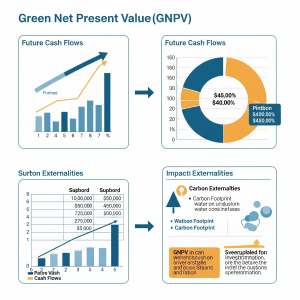
Green NPV extends the traditional NPV calculation by factoring in the costs and benefits of carbon emissions and climate impacts.
How it works:
- Carbon costs: Incorporate the price of carbon (through taxes, emissions trading, or internal carbon pricing) as a real cash outflow.
- Sustainability benefits: Include expected revenue from green incentives, subsidies, or increased market share due to sustainability leadership.
- Risk adjustments: Adjust discount rates or cash flows to reflect climate risks, such as regulatory changes, stranded assets, or reputational damage.
Benefits:
- Aligns investment decisions with long-term climate goals.
- Encourages capital allocation to low-carbon, resilient projects.
- Makes the business case for emissions reduction visible in financial terms.
Brown Penalty
Definition:
A brown penalty is a negative adjustment applied to the valuation or expected returns of carbon-intensive (“brown”) assets or projects.
How it works:
- Higher cost of capital: Investors may demand higher returns for brown assets, reflecting climate and transition risks.
- Lower valuations: Markets may discount the value of companies or projects with high carbon footprints.
- Regulatory penalties: Anticipated or actual costs from carbon taxes, emissions caps, or legal liabilities are factored into financial models.
Implications:
- Brown penalties make polluting projects less attractive.
- They help shift investment towards cleaner, greener alternatives.
- Over time, they can drive systemic change in capital markets.
ESG and the Role of Carbon Accounting
What is ESG?
Environmental, Social, and Governance (ESG) refers to the three central factors in measuring the sustainability and societal impact of an investment in a company or business. ESG metrics are increasingly used by investors to screen investments, assess risks, and drive positive impact.
Carbon Accounting as the “E” in ESG
- Environmental pillar: Carbon emissions are a core metric for the environmental component of ESG.
- Disclosure: Transparent carbon accounting is essential for credible ESG reporting.
- Performance: Investors and stakeholders favour companies that demonstrate emissions reductions and robust climate strategies.
ESG Ratings and Investment
- ESG ratings agencies use carbon data to score companies.
- Funds with ESG mandates increasingly divest from high-emission (brown) assets and favour green leaders.
- Companies with strong ESG performance often enjoy lower borrowing costs, higher valuations, and better stakeholder trust.
Challenges and Evolving Practices in Carbon Accounting
Data Quality and Availability
- Scope 3 complexity: Gathering accurate data from suppliers and downstream partners is challenging but critical.
- Standardisation: Emission factors and reporting practices vary by country and sector.
Double Counting and Boundaries
- Emissions can be double-counted across value chains if boundaries are not clearly defined.
- Frameworks like the GHGP help clarify organisational and operational boundaries.
Dynamic Regulatory Landscape
- Carbon pricing, disclosure mandates, and climate risk regulations are evolving rapidly.
- Companies must stay abreast of new rules and adapt their accounting systems accordingly.
Technology and Automation
- AI and digital platforms are making data collection, calculation, and reporting more efficient and accurate.
- Blockchain and IoT are emerging as tools for real-time, tamper-proof emissions tracking.
Future Trends: The Road Ahead for Carbon Accounting and Green Finance
Integration with Financial Reporting
- Carbon accounting is becoming as fundamental as financial accounting.
- Regulators in the EU, UK, and other markets are moving toward mandatory climate disclosures alongside traditional financial statements.
Internal Carbon Pricing
- Many companies now set an internal price on carbon to guide investment decisions, incentivise emissions reduction, and prepare for future regulation.
Linking to Executive Compensation
- Some leading firms tie executive bonuses to emissions reduction targets, aligning leadership incentives with climate goals.
Supply Chain Decarbonisation
- Companies are increasingly requiring suppliers to report and reduce their own emissions, driving change across entire value chains.
Impact on Mergers, Acquisitions, and Lending
- Carbon footprints and climate risks are now material factors in M&A due diligence and loan underwriting.
- Brown penalties and green premiums are reshaping asset valuations.
Summary
Carbon accounting is the backbone of climate action in the business world, enabling organisations to measure, manage, and reduce their greenhouse gas emissions. By adopting robust methodologies-spend-based, activity-based, or hybrid-companies can accurately quantify their carbon footprint, comply with regulations, and build trust with stakeholders. The integration of green NPV and brown penalty concepts into financial analysis ensures that climate risks and opportunities are reflected in investment decisions, while ESG frameworks drive transparency, accountability, and sustainable growth. As carbon accounting matures and becomes embedded in global finance, it will play a central role in steering the world towards a low-carbon, resilient future.