





 Theodora Chapman
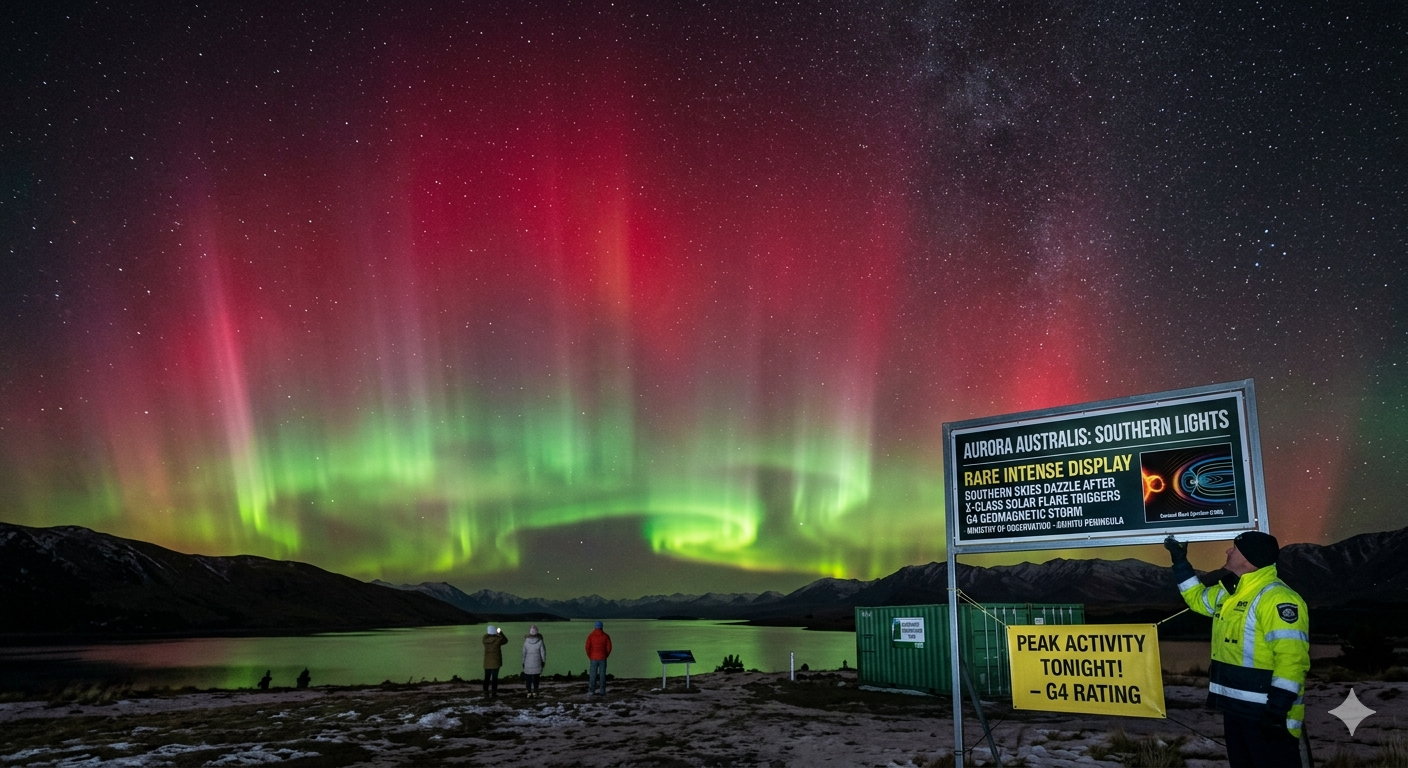
 A G2-class geomagnetic storm watch is in effect for Tuesday night following an X1.4 solar flare eruption, with aurora australis potentially visible across parts of New Zealand’s South Island and southern mainland.
By Theodora Chapman
Wildlife Conservation and Environmental Writer
Zealandia News
March 31, 2026 — WELLINGTON
Stargazers across southern New Zealand could be treated to a rare display of the southern lights tonight after the sun unleashed a powerful X1.4 solar flare late on March 29, sending a coronal mass ejection hurtling toward Earth. The Space Weather Prediction Center has issued a G2 (Moderate) geomagnetic storm watch for March 31 UTC-day, with the potential for auroral displays extending further toward the equator than usual.
The solar flare, which erupted from Region 4405 in the southeast quadrant of the sun, was associated with a “fairly fast” coronal mass ejection that is expected to deliver a glancing blow to Earth’s magnetic field . While the eruption was impressive, early analysis suggests much of the coronal mass ejection was directed east of Earth and partially blocked by a neighbouring coronal hole, meaning the impact will be less direct than if the flare had been fully Earth-directed.
For observers in New Zealand, the timing is favourable. The G2 storm watch coincides with the March 31 UTC-day, which translates to Tuesday night local time. Skywatchers in the South Island — particularly in Otago, Southland, and Canterbury — stand the best chance of seeing the aurora australis, though clear skies and dark conditions away from city lights will be essential.
What Causes the Southern Lights?
The aurora australis, like its northern counterpart, occurs when charged particles from the sun interact with Earth’s magnetic field and upper atmosphere. When a coronal mass ejection reaches Earth, it compresses the magnetosphere, funnelling energetic particles toward the polar regions. These particles collide with atmospheric gases, exciting oxygen and nitrogen molecules that release energy as light — green and red from oxygen, blue and purple from nitrogen.
The strength of geomagnetic storms is measured on a scale from G1 (minor) to G5 (extreme). A G2 storm is considered moderate, capable of producing auroras visible at lower latitudes than usual. While New Zealand’s South Island frequently sees auroral activity during strong geomagnetic storms, a G2 event increases the likelihood of sightings across a broader area, including potentially as far north as the lower North Island under ideal conditions.
Solar Activity on the Rise
Tonight’s potential display comes after an active year for solar activity. The sun is currently in the peak phase of Solar Cycle 25, which began in December 2019 and is expected to reach its maximum between 2025 and 2026. This cycle has already produced several significant geomagnetic storms, including a G4 event in November that made the northern lights visible as far south as Texas in the United States .
The current solar maximum is proving more active than initial forecasts predicted. Scientists attribute this to the complex magnetic dynamics of this particular cycle, which has generated a higher number of X-class flares — the most powerful category — than anticipated. X-class flares can cause radio blackouts and disrupt satellite operations, though the effects of glancing blows such as the one expected tonight are typically milder.
How and Where to Watch
For those hoping to catch a glimpse of the aurora australis, conditions need to align. The storm’s timing is critical — the peak of geomagnetic activity is expected during the March 31 UTC-day, which translates to daylight hours in New Zealand. However, coronal mass ejections can produce extended periods of heightened activity, and if the storm persists into the evening, viewing opportunities could emerge after dark.
Clear skies are essential, as cloud cover will obscure any display. The moon, currently in its waxing gibbous phase, will be bright but sets in the early morning hours, offering a window of darker conditions in the late night. Observers should seek locations with an unobstructed view to the south, away from urban light pollution. Coastal areas of Otago and Southland, as well as the Mackenzie Basin’s dark sky reserve, are traditionally favoured spots for aurora viewing.
Aurora forecasts are updated regularly through the Space Weather Prediction Center and by New Zealand’s own geological hazard monitoring services. Enthusiasts typically monitor real-time data from magnetometers, which measure disturbances in Earth’s magnetic field, to gauge the likelihood of visible activity.
Broader Implications of Space Weather
While auroral displays are a spectacular side effect of solar activity, geomagnetic storms have practical consequences. G2 storms can cause voltage fluctuations in power grids, disrupt satellite communications, and affect high-frequency radio transmissions. Airlines sometimes reroute polar flights during significant storms to avoid radio blackouts and increased radiation exposure at high altitudes.
The increasing reliance on satellite infrastructure for navigation, telecommunications, and weather monitoring has made space weather forecasting an area of growing importance. Agencies worldwide, including New Zealand’s own geological and meteorological services, monitor solar activity to provide advance warning of potentially disruptive events.
A Reminder of the Sun’s Power
For most New Zealanders, tonight’s potential display is simply an opportunity to witness one of nature’s most beautiful phenomena. The aurora australis has long held a place in the cultural traditions of Te Waipounamu, the South Island, where Māori oral tradition describes the southern lights as tūārau-ā-rangi, a celestial phenomenon associated with the spirits of ancestors.
Whether tonight’s display materialises depends on factors that remain uncertain until the coronal mass ejection arrives. But the very possibility serves as a reminder of the dynamic relationship between Earth and the sun — a connection that produces not only the light of day but, on rare occasions, lights that dance across the southern sky long after the sun has set.
In Brief
An X1.4 solar flare that erupted on March 29 has triggered a G2 geomagnetic storm watch for March 31, with the potential for the aurora australis to be visible across parts of southern New Zealand tonight. The glancing blow from the coronal mass ejection may produce moderate geomagnetic activity, offering skywatchers in the South Island the best chance of witnessing the southern lights. While the storm’s timing means the peak activity coincides with daylight hours, observers are advised to monitor updates and seek dark, south-facing locations after nightfall. The event comes amid heightened solar activity during Solar Cycle 25, which has already produced several significant geomagnetic storms over the past year.