



 Vinay Karanam
 In the analogue world, identity was often defined by what we carried—passports, licences, or physical credentials. In the digital era, however, our identity is fragmented, duplicated, and monetised across countless platforms and databases, often without our consent or knowledge.
From accessing government services to opening bank accounts, verifying age, or signing up for a social network, identity is central to almost every interaction online. Yet the systems underpinning digital identity remain dangerously fragile, centralised, and exposed. Data breaches, identity theft, surveillance capitalism, and social exclusion are daily realities for millions.
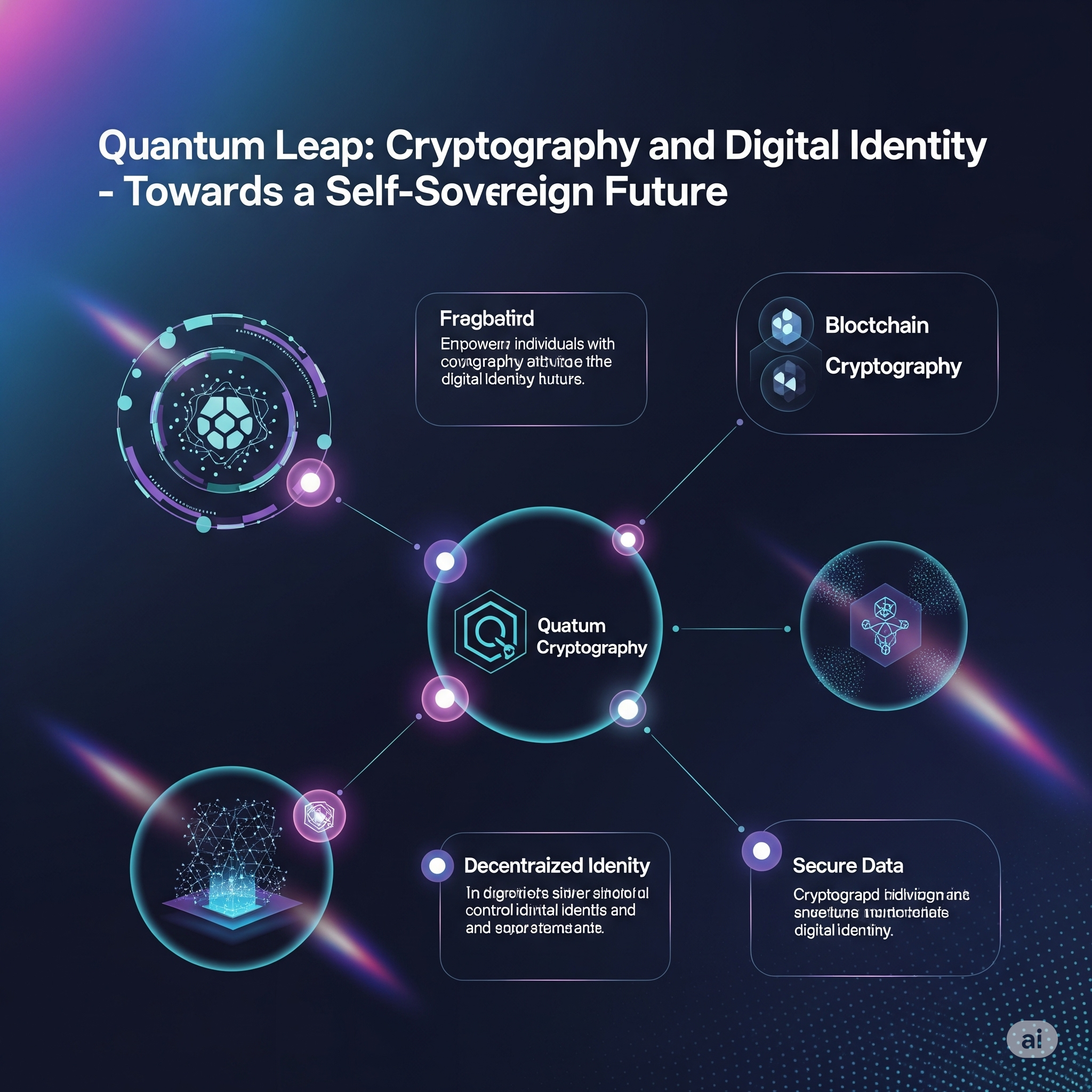
In this 72nd article of the Quantum Leap series, we examine how cryptography is driving a paradigm shift in digital identity, enabling self-sovereign identity (SSI)—a model in which individuals, not corporations or states, own and control their personal data.
We explore the cryptographic foundations of SSI, including decentralised identifiers (DIDs), verifiable credentials (VCs), and zero-knowledge proofs (ZKPs), and assess how quantum-resistant methods are shaping the identity systems of the future.
Section I: The Identity Crisis – Centralisation, Exploitation, and Risk
1. Centralised Identity Systems
Most digital identity frameworks rely on centralised authorities—governments, financial institutions, social media platforms—that issue, store, and validate identity information.
This model suffers from several major flaws:
- Single points of failure: One breach can expose millions of records (e.g. Aadhaar, Equifax, Facebook leaks).
- Data silos: Individuals must repeatedly share personal data with each new service.
- Lack of interoperability: Systems often don’t “talk” to each other, complicating cross-border identity use.
- Lack of user control: Once shared, individuals lose visibility and control over how their data is used.
In many parts of the world, especially in the Global South, identity systems are also plagued by:
- Exclusion: Refugees, stateless individuals, and people without access to documentation are denied basic services.
- Discrimination: Biometric and algorithmic systems often amplify existing inequalities.
2. Identity as Surveillance and Commodity
In the age of surveillance capitalism, identity is no longer just about verification. It is extracted, profiled, and commodified:
- Data brokers collect, bundle, and sell identity data.
- Social media profiles become behavioural dossiers.
- States deploy facial recognition to monitor citizens.
Cryptography offers an alternative—privacy-preserving, decentralised identity that is both verifiable and under the individual’s control.
Section II: The Rise of Self-Sovereign Identity (SSI)
1. Principles of SSI
The self-sovereign identity movement seeks to reverse the dominant model by putting the user at the centre. SSI is built around these key principles:
- Control: Individuals control their identity data and how it is shared.
- Portability: Identity is not tied to any single provider.
- Minimal disclosure: Only the necessary information is shared.
- Interoperability: Works across borders and platforms.
- Persistence: Identities are long-lived but revocable.
2. Key Technologies of SSI
SSI relies on a combination of decentralised and cryptographic technologies, including:
- Decentralised Identifiers (DIDs)
- Verifiable Credentials (VCs)
- Distributed ledgers or blockchains (to anchor trust)
- Zero-Knowledge Proofs (ZKPs)
- Digital wallets (to store and manage identity data)
Each of these components brings a layer of security, verifiability, and user agency.
Section III: Decentralised Identifiers (DIDs)
1. What is a DID?
A Decentralised Identifier (DID) is a globally unique identifier that does not rely on a central registry or certificate authority. For example:
makefileCopyEditdid:example:123456789abcdefghi
Unlike email addresses or usernames, DIDs are:
- Cryptographically generated
- Owned and controlled by the user
- Anchored to a DID document (containing public keys and service endpoints)
- Resolvable across decentralised networks
2. How DIDs Work
Each DID maps to a public-private key pair. The private key is held by the user, while the public key is available in the DID Document. DIDs can be rotated or revoked without altering the identity.
DIDs are network-neutral. They can be registered on:
- Public blockchains (e.g. Ethereum, Hyperledger Indy)
- Permissioned ledgers (e.g. Sovrin)
- Off-chain registries (e.g. peer DIDs)
3. DID Methods
The DID Method defines how a specific DID is created, resolved, and deactivated. Examples:
did:btcr:(Bitcoin-based)did:ethr:(Ethereum-based)did:key:(no blockchain dependency)
This modularity allows for ecosystem-wide interoperability and future-proofing.
Section IV: Verifiable Credentials (VCs)
1. What is a Verifiable Credential?
A Verifiable Credential is a tamper-evident, digitally signed assertion made by an issuer about a subject. It consists of:
- Subject: The entity the credential refers to (e.g. a person)
- Issuer: The entity issuing the credential (e.g. a university)
- Claims: The information contained (e.g. degree, date)
- Proof: A digital signature linking it to the issuer’s DID
2. Examples of VCs
- University diplomas
- Driving licences
- Health certificates (e.g. vaccination records)
- Employee IDs
- Age or residency proofs
VCs are stored in digital wallets controlled by users and presented selectively to verifiers.
3. Selective Disclosure
Using ZKPs or cryptographic hash commitments, individuals can:
- Prove they are over 18 without disclosing their birthdate
- Prove residency without revealing full address
- Prove qualification without disclosing grades
This approach reduces data exposure and greatly enhances privacy.
Section V: Cryptographic Foundations
1. Digital Signatures
Digital signatures ensure the authenticity and integrity of credentials. Common algorithms include:
- ECDSA (Elliptic Curve Digital Signature Algorithm)
- EdDSA (Ed25519, Ed448)
- RSA (though increasingly deprecated in identity contexts)
Each credential is signed by the issuer’s private key, and anyone can verify its validity using the public key in the DID Document.
2. Zero-Knowledge Proofs
ZKPs enable users to prove knowledge of a value without revealing the value itself. In SSI, ZKPs are used for:
- Selective disclosure
- Revocation proofs
- Anonymous credentials (e.g. zk-SNARKs, Bulletproofs, Idemix)
ZKPs add a layer of privacy and security critical for real-world applications.
3. Revocation and Audit Trails
Revocation registries, often anchored to blockchains, allow issuers to:
- Revoke a credential (e.g. expired licence)
- Update claims
- Maintain auditability without breaching privacy
Cryptographic mechanisms such as Merkle trees or Accumulator sets enable scalable, anonymous revocation.
Section VI: Real-World Applications and Use Cases
1. Government Services
Countries such as Canada, Estonia, and New Zealand are exploring SSI to deliver:
- Healthcare access
- Benefits distribution
- Passport verification
- Tax filings
In New Zealand, RealMe could potentially evolve toward a DID-compatible framework, offering user-managed credentials across public and private sectors.
2. Education and Employment
SSI can streamline:
- Credential verification during hiring
- Fraud-resistant academic transcripts
- International credential portability
Universities can issue digitally signed degrees that are instantly verifiable across borders.
3. Healthcare
- Vaccine passports (e.g. EU’s Digital COVID Certificate)
- ePrescription authentication
- Patient data portability
- Privacy-preserving health trials
SSI ensures health data is shared intentionally, not indiscriminately.
4. Financial Services (KYC/AML)
SSI can simplify Know Your Customer (KYC) processes while enhancing privacy. Instead of sharing a full ID document, users can present cryptographically verified attributes (e.g. age, residency).
This reduces regulatory burden while enhancing user trust.
Section VII: The Quantum Future – Challenges and Readiness
1. Vulnerabilities in Current Systems
Most current identity systems rely on public-key cryptography (RSA, ECC), which are vulnerable to Shor’s algorithm on a future quantum computer.
Quantum threats could:
- Forge digital signatures
- Impersonate users
- Corrupt verification processes
2. Post-Quantum Cryptography for SSI
Emerging post-quantum signature schemes—standardised by NIST—are being tested for use in DID and VC frameworks:
- Dilithium and FALCON (for digital signatures)
- SPHINCS+ (stateless hash-based scheme)
- Kyber (for secure messaging)
These quantum-safe schemes must be integrated carefully to balance performance, size, and compatibility.
3. Quantum Identity Protocols
Theoretical models also explore quantum-based identity, such as:
- Quantum tokens for unforgeable IDs
- QKD-backed DID networks
- Quantum-resistant wallets for key storage
While not yet mainstream, they offer long-term defence-in-depth for digital identity systems.
Section VIII: Risks, Ethics, and Inclusion
1. Digital Inequality
SSI depends on access to:
- Smart devices
- Internet connectivity
- Digital literacy
Care must be taken to not exclude the most vulnerable, including indigenous populations, seniors, and those without formal documentation.
2. Trust and Governance
- Who sets the rules for DID registries?
- How are revocation lists maintained?
- How is consent recorded and honoured?
Governance models must be transparent, decentralised, and accountable.
3. Data Sovereignty
Countries must retain control over their identity infrastructure while ensuring global interoperability. This calls for open standards and multi-stakeholder frameworks, not top-down digital colonialism.
Conclusion: The Cryptographic Citizen
As the world transitions from analogue credentials to digital personas, cryptography is emerging as the backbone of a secure, inclusive, and private identity future. Self-sovereign identity is not merely a technical shift—it is a civil rights imperative for the digital age.
By allowing individuals to own and selectively share their identity information—backed by cryptographic trust—SSI can unlock a new era of autonomy, dignity, and digital democracy.
In the next article, we’ll examine how cryptography is shaping the future of mobility, with a deep dive into secure automotive systems, smart transport infrastructure, and vehicle-to-vehicle (V2V) communication.
© 2025 New Zealand Bharat News. All rights reserved.
Contact: admin@nzb.news | Follow us @nzb.news