




 Vincent Mathews
 On 24 April 2025, China launched the Shenzhou-20 mission, sending three astronauts—Chen Dong, Chen Zhongrui, and Wang Jie—to the Tiangong space station, marking the country’s 15th crewed spaceflight and a significant milestone in its ambitious space programme. This mission, part of a regular rotation to maintain continuous human presence aboard Tiangong, underscores China’s growing prowess in space exploration, driven by a vision to rival the United States and achieve a crewed lunar landing by 2030. Amid global competition and domestic pride, the Shenzhou-20 mission highlights China’s technological advances, international aspirations, and the challenges of sustaining its “space dream.” This article explores the mission’s context, details, diverse perspectives, historical backdrop, and potential future trajectories for China’s space endeavours.
A Foundation in the Stars: Background of China’s Space Programme
China’s space programme, overseen by the China National Space Administration (CNSA) and rooted in military origins, began in the 1950s with missile development. The establishment of the People’s Liberation Army Astronaut Corps in 1998 marked a pivotal step toward human spaceflight. In 2003, Yang Liwei’s Shenzhou-5 mission made China the third nation, after the Soviet Union and the United States, to independently send a human into space. Subsequent milestones included the first Chinese spacewalk by Zhai Zhigang in 2008, the first woman in space, Liu Yang, in 2012, and the first female spacewalker, Wang Yaping, in 2021.
The Tiangong space station, meaning “Heavenly Palace,” was completed in 2022 after the launch of its three modules: Tianhe (core), Wentian, and Mengtian. Orbiting at 400–450 kilometres above Earth, Tiangong is designed to operate for at least 15 years, hosting rotating crews of three astronauts for six-month missions. Unlike the International Space Station (ISS), which excludes China due to U.S. restrictions, Tiangong is a national project but increasingly open to international collaboration, as evidenced by plans to host a Pakistani astronaut in 2026.
China’s broader ambitions include landing astronauts on the Moon by 2030, building a lunar research station by 2035, and exploring Mars and Jupiter. The programme reflects President Xi Jinping’s vision of a “strong China,” with space exploration symbolising technological and geopolitical clout. As of April 2025, 26 Chinese nationals have travelled to space, with the Shenzhou-20 crew advancing this legacy through scientific experiments and infrastructure maintenance.
The Shenzhou-20 Mission: Context and Significance
The Shenzhou-20 mission launched against a backdrop of intensifying global space competition, particularly with the United States, which aims to return astronauts to the Moon by late 2025 via NASA’s Artemis programme. China’s space efforts, bolstered by consistent funding and political will, contrast with U.S. budget uncertainties, with NASA facing potential cuts under the Trump administration. The mission also follows China’s 2024 successes, including the Chang’e-6 probe’s retrieval of samples from the Moon’s far side and the Shenzhou-19 crew’s experiments with lunar bricks and AI robots.
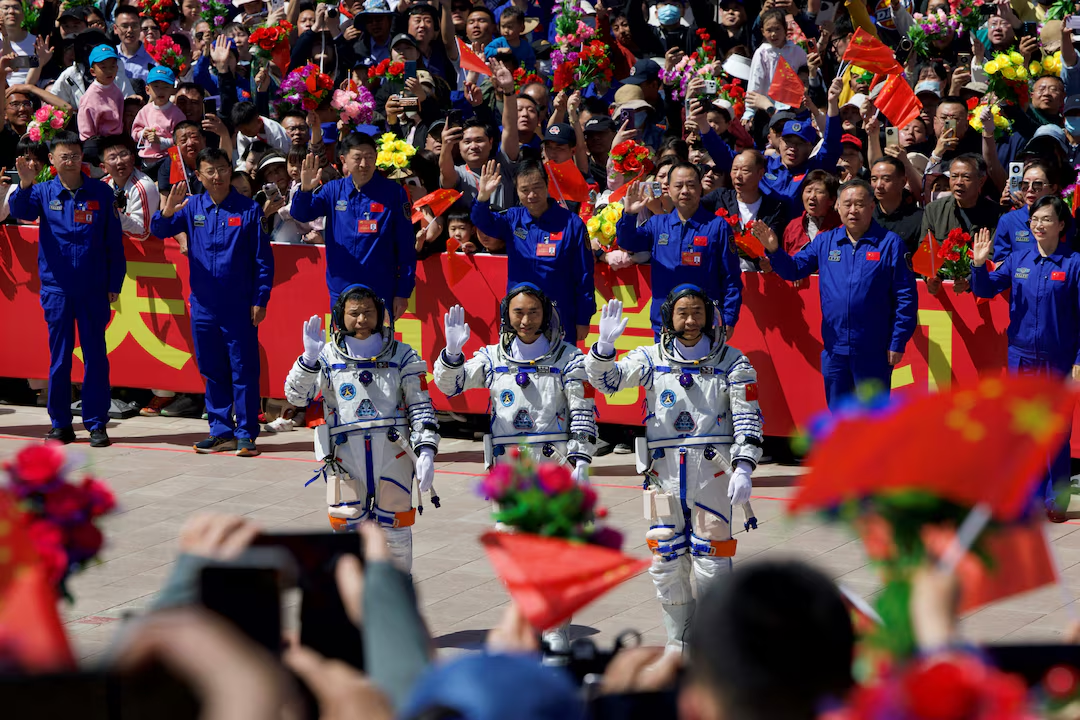
Launched on 24 April 2025 from the Jiuquan Satellite Launch Centre in Gansu province, Shenzhou-20 carried a veteran and two newcomers to Tiangong, replacing the Shenzhou-19 crew, who returned to Earth on 29 April. The mission coincided with domestic celebrations, with crowds waving flags and children chanting the astronauts’ names, reflecting national pride. Internationally, the mission drew attention for its inclusion of a Pakistani astronaut candidate in training, signalling China’s push for space diplomacy.
The timing, just before the Lunar New Year, amplified public engagement, with state media framing the mission as a symbol of China’s unstoppable rise. However, U.S. Space Command’s General Stephen Whiting warned of China’s growing orbital capabilities, citing a “kill web” of surveillance satellites, highlighting geopolitical tensions. Despite this, CNSA officials, like Li Yingliang, emphasised peaceful exploration, dismissing competition as secondary to humanity’s collective goals.
Details of the Shenzhou-20 Mission
Launch and Crew
At 5:17 PM local time (9:17 PM NZST) on 24 April 2025, the Shenzhou-20 spacecraft lifted off atop a Long March-2F rocket from Jiuquan, docking with Tiangong’s Tianhe module six hours later. The crew comprised:
- Chen Dong, 46, mission commander and former fighter pilot, who in 2022 became the first Chinese astronaut to log over 200 days in orbit (Shenzhou-11, Shenzhou-14).
- Chen Zhongrui, 40, a former air force pilot making his first spaceflight.
- Wang Jie, 35, a former space technology engineer, also on his debut mission.
The all-male trio, selected from the People’s Liberation Army Astronaut Corps, underwent rigorous training for spacecraft operations, spacewalks, and scientific experiments. Their send-off ceremony, broadcast live by China Central Television (CCTV), featured military salutes and patriotic anthems, with hundreds cheering in the Gobi Desert.
Mission Objectives
During their six-month stay, ending in October 2025, the crew will:
- Conduct 80–90 experiments in space life sciences, microgravity physics, and materials, including studies on planarians (regenerative flatworms) and brainwave monitoring to assess long-duration spaceflight effects.
- Perform two spacewalks to install space debris shields and maintain Tiangong’s robotic arm and solar panels.
- Test technologies for lunar missions, such as resource-efficient food systems and radiation-resistant materials.
- Oversee the arrival of a Tianzhou cargo spacecraft in July 2025, delivering supplies and fuel.
The crew overlapped briefly with the Shenzhou-19 team— Cai Xuzhe, Song Lingdong, and Wang Haoze—for a handover, ensuring continuity. The mission’s scientific focus builds on Shenzhou-19’s work, like lunar brick exposure tests, critical for China’s planned lunar base.
Public and Media Engagement
CCTV’s live coverage, viewed by millions, showcased the launch’s fiery ascent and the crew’s arrival at Tiangong. Social media platforms like Weibo and X buzzed with posts, with #Shenzhou20 trending and users sharing clips of the rocket’s roar. In New Zealand, the Chinese diaspora organised watch parties in Auckland, while Wellington’s Chinese embassy hosted a lecture on Tiangong’s contributions. State media highlighted Chen Dong’s leadership, framing the mission as a step toward lunar ambitions.
Perspectives on China’s Space Programme: A Multifaceted View
The Shenzhou-20 mission elicited diverse reactions, reflecting China’s complex role in global space exploration.
National Pride and Public Sentiment
For Chinese citizens, the mission is a source of immense pride, symbolising technological self-reliance and global stature. Crowds at Jiuquan and posts on Weibo, like those calling the crew “heroes of the stars,” reflect this sentiment. State media’s portrayal of Tiangong as a “celestial palace” resonates with cultural narratives of imperial greatness, while youth engagement—evident in astronaut-themed toys and school projects—ensures longevity. However, some netizens questioned the programme’s cost, estimated at $10 billion annually, amid economic challenges.
International Space Community
Global scientists welcome China’s contributions, particularly Tiangong’s experiments in microgravity and life sciences, which complement ISS research. Quentin Parker, an astrophysicist at the University of Hong Kong, praised the Pakistani astronaut initiative as a step toward internationalisation, potentially rivalling the ISS’s collaborative model. However, NASA’s exclusion of China, rooted in 2011 U.S. legislation, limits direct cooperation, with some Western analysts arguing this fuels a space race.
Geopolitical Tensions
U.S. officials, like General Whiting, view China’s orbital assets—over 300 satellites by 2024—as a strategic threat, citing potential military applications. This contrasts with CNSA’s peaceful rhetoric, though Tiangong’s military ties fuel suspicion. Allies like Pakistan and Belt and Road partners see China’s programme as a counterweight to U.S. dominance, with Islamabad’s space agency, SUPARCO, lauding the Shenzhou-20 mission as a milestone for South-South cooperation.
Academic and Ethical Debates
Academics note China’s rapid progress, with successes like Chang’e-6 outpacing some NASA efforts. However, concerns persist about transparency, given the programme’s military oversight and limited data sharing. Ethical questions also arise over space debris risks, with Tiangong’s operations adding to orbital clutter, and the ecological impact of frequent launches. Some environmentalists call for greener rocket fuels, though CNSA prioritises reliability.
Historical Context: Milestones and Setbacks
China’s space journey reflects resilience and ambition:
- 1960s–1970s: The Shuguang-1 project aimed for a 1973 crewed flight but was derailed by political purges during the Cultural Revolution, delaying human spaceflight.
- 2003: Yang Liwei’s Shenzhou-5 orbit made China the third nation to achieve crewed spaceflight, followed by Shenzhou-6 (2005) and Shenzhou-7’s spacewalk (2008).
- 2011–2016: Tiangong-1 and Tiangong-2, temporary stations, tested docking and life support, paving the way for Tiangong’s permanent presence.
- 2020–2022: The Tianwen-1 Mars mission and Tiangong’s completion showcased China’s multitasking, though Tiangong-1’s uncontrolled re-entry in 2018 drew criticism for debris risks.
- 2023–2024: The inclusion of civilian astronaut Gui Haichao and female engineer Wang Haoze marked diversity, while Chang’e-6’s lunar samples solidified China’s lead in lunar exploration.
Setbacks, like the 1996 Long March-3B crash, taught reliability, while political isolation from the ISS spurred self-reliance. The programme’s military roots, with all astronauts drawn from the air force until 2023, contrast with its recent openness to civilians and foreigners, reflecting strategic shifts.
Connecting the Dots: Future Trajectories for China’s Space Programme
The Shenzhou-20 mission offers insights into China’s space future:
Lunar Ambitions
By 2030, China aims to land astronauts on the Moon, using the Long March-10 rocket and a lunar rover, Tansuo. Shenzhou-20’s experiments, like resource-efficient systems, are stepping stones. Success could position China as a lunar leader, especially if U.S. Artemis delays persist. However, technical challenges, like lunar landing precision, and funding demands—potentially $20 billion—pose risks.
Tiangong’s Evolution
Tiangong may expand with new modules by 2030, increasing capacity for experiments and international crews. The planned Xuntian telescope, launching in 2026, will co-orbit for servicing, mirroring Hubble’s model. Pakistan’s 2026 astronaut mission could pave the way for more partners, like Belt and Road nations, though language barriers (Tiangong uses only Chinese) may limit collaboration.
Deep Space Exploration
The Tianwen-3 (2028) and Tianwen-4 (2029) missions target Mars sample return and Jupiter exploration, respectively. A proposed Triton mission (2039) reflects long-term vision, but funding and technical hurdles, like propulsion for outer planets, are daunting. China’s Deep Space Exploration Laboratory, established in 2022, will drive these efforts, potentially outpacing NASA if U.S. budgets shrink.
Geopolitical and Commercial Impacts
China’s space diplomacy, via partnerships with Pakistan, Italy, and France, counters U.S. isolation. Commercial ventures, like Ceres-1 rockets, may grow, though state control limits private innovation compared to SpaceX. Geopolitically, Tiangong could become the sole crewed station post-ISS (2030), enhancing China’s influence, but militarisation fears may deter some partners.
Challenges include sustaining funding amid economic slowdown, managing debris (China’s 2019 anti-satellite test added 3,000 fragments), and navigating U.S.-China tensions. Transparency and environmental accountability will be critical to maintain global goodwill.
Personal Opinion: A Bold but Balanced Path
As a journalist, I find China’s space programme, epitomised by Shenzhou-20, a testament to human ambition and ingenuity. The sight of a Long March-2F rocket piercing the Gobi Desert sky, carrying dreams of lunar bases and Martian rovers, is awe-inspiring. Chen Dong’s leadership and the crew’s experiments reflect a nation pushing boundaries, undeterred by decades of exclusion from Western collaboration.
Yet, I’m cautious about the programme’s military opacity and environmental footprint. The “kill web” narrative, while alarmist, underscores the need for trust-building measures, like open data sharing. I applaud the Pakistani astronaut initiative but hope China embraces broader, ISS-style cooperation, leveraging Tiangong’s potential as a global lab. The focus on youth, from astronaut figurines to school curricula, ensures longevity, but costs must be justified to taxpayers.
Looking ahead, I believe China can lead in lunar exploration if it balances ambition with transparency. Shenzhou-20 is a bridge to that future, reminding us that space, while a frontier of competition, is ultimately a shared human endeavour. New Zealand, with its growing space sector, could engage China on satellite projects, fostering peaceful exchange.
Summary: China’s Celestial Momentum
The Shenzhou-20 mission, launched on 24 April 2025, marks a high point in China’s space journey, with astronauts Chen Dong, Chen Zhongrui, and Wang Jie advancing Tiangong’s scientific and operational goals. Rooted in a programme that achieved crewed flight in 2003 and a permanent station in 2022, the mission reflects China’s rise as a space power, driven by lunar and Martian ambitions. Public pride, international intrigue, and geopolitical tensions shape its narrative, with historical milestones like Shenzhou-5 and setbacks like Shuguang-1 informing its path. Future trajectories point to lunar landings, Tiangong’s expansion, and deep space missions, though funding, transparency, and debris challenges loom. As Shenzhou-20’s crew experiments in orbit, China stands at a crossroads, poised to redefine humanity’s cosmic frontier with boldness and responsibility.