 Vinay Karanam
 By New Zealand Bharat News (NZB News)
Game theory, a fascinating blend of mathematics, economics, and psychology, has spent decades shaping how we understand decision-making in competitive and cooperative scenarios. From negotiating trade deals to designing artificial intelligence, this field offers a lens into the strategies that govern human and machine behaviour. As New Zealand navigates a complex global landscape—be it in economics, technology, or environmental policy—game theory provides tools to predict, plan, and prosper. In this feature, NZB News dives into the origins, principles, and far-reaching impact of game theory, exploring its classical roots, quantum leaps, and future promise.
Background Information: A Strategic Evolution
Game theory traces its formal origins to the mid-20th century, though its concepts echo through history—from ancient military tactics to philosophical debates about human nature. It gained prominence with the 1944 publication of Theory of Games and Economic Behavior by John von Neumann and Oskar Morgenstern, widely considered the field’s foundational text. This work transformed scattered ideas into a rigorous mathematical framework, sparking a revolution across disciplines.
Over the decades, game theory has grown from an abstract curiosity into a practical powerhouse. It’s earned multiple Nobel Prizes, influenced global policy, and infiltrated everyday life—whether you’re haggling at a Kiwi market or playing a board game with mates. Today, as we stand in 2025, game theory’s reach extends into artificial intelligence, quantum physics, and beyond, making it a vital tool for understanding our interconnected world.
What is Game Theory?
Game theory is the study of strategic decision-making, where the outcome for each participant (or “player”) depends not just on their own choices but on the choices of others. It’s like a chess match: your move matters, but so does your opponent’s, and success hinges on anticipating their strategy.
Key elements define a game:
- Players: Individuals, groups, or entities making decisions (e.g., two companies in a pricing war).
- Strategies: The possible actions each player can take (e.g., lower prices or hold steady).
- Payoffs: The outcomes or rewards each player receives based on the combination of strategies (e.g., profit, loss, or a draw).
- Rules: The structure governing how decisions are made and payoffs assigned.
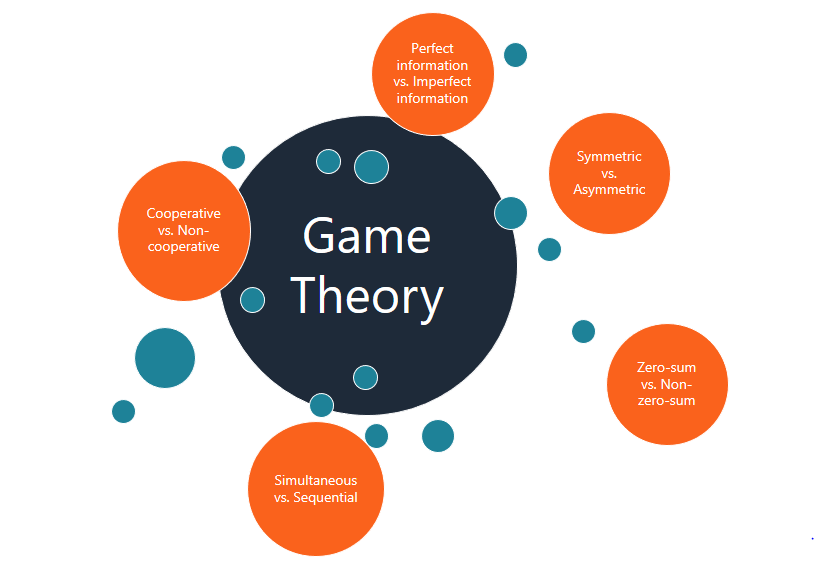
Games can be cooperative (players work together, like nations in a climate pact) or non-cooperative (players compete, like bidders at an auction). A famous example is the Prisoner’s Dilemma, where two suspects must decide whether to confess or stay silent, with their fates intertwined. The “best” choice for one depends on what the other does, highlighting the tension between individual and collective gain—a scenario Kiwis might recognise in resource-sharing debates.

How Did Game Theory Emerge?
Game theory’s roots stretch back centuries—think of Chanakya Neeti or early economic ideas about competition—but its modern form emerged from specific intellectual currents:
- Early Sparks: In the 1920s, mathematician Émile Borel explored strategic games, laying groundwork.
- Von Neumann’s Leap: John von Neumann’s 1928 paper on parlour games introduced a minimax theorem—finding the best strategy in zero-sum games (where one player’s gain is another’s loss). His 1944 book with Morgenstern expanded this to economics, birthing game theory as a discipline.
- Cold War Catalyst: The 1950s saw game theory thrive amid nuclear standoffs, as strategists like John Nash analysed conflict and cooperation, formalising ideas like the Nash Equilibrium (where no player can improve their payoff by changing strategy alone).
This emergence wasn’t accidental—it reflected a world wrestling with complexity, from wartime tactics to post-war economics. By the late 20th century, game theory had become a multidisciplinary titan.

Some Notable Contributions
Game theory owes its depth to brilliant minds:
- John von Neumann (1903–1957): The Hungarian genius co-founded the field, introducing minimax and utility theory, blending maths with economics.
- Oskar Morgenstern (1902–1977): His collaboration with von Neumann grounded game theory in real-world behaviour.
- John Nash (1928–2015): His Nash Equilibrium revolutionised non-cooperative games, earning a 1994 Nobel Prize. His life inspired A Beautiful Mind.
- Thomas Schelling (1921–2016): A Cold War strategist, he applied game theory to deterrence and negotiation, winning a Nobel in 2005.
- Robert Aumann (1930–): His work on repeated games showed how cooperation emerges over time, also earning a 2005 Nobel.
New Zealand’s own scholars, like those at the University of Auckland, contribute today, applying game theory to local issues like fisheries management and trade policy.

Notable Problems Game Theory Helped Solve
Game theory has cracked some tough nuts:
- Nuclear Deterrence: During the Cold War, Schelling’s models explained why mutually assured destruction (MAD) prevented escalation—a grim but effective balance.
- Auction Design: Game theory shaped modern auctions, like the 1994 US spectrum auctions, raising billions by predicting bidder behaviour.
- Traffic Flow: Nash-inspired models optimise road networks, reducing congestion—a boon for Auckland commuters.
- Evolutionary Biology: John Maynard Smith’s “evolutionarily stable strategy” explained animal behaviours, like why stags don’t always fight.
These solutions show game theory’s knack for turning chaos into clarity, whether in war rooms or ecosystems.

Diverse Applications
Game theory’s versatility spans industries:
- Economics: It predicts market competition, like how Air New Zealand and Qantas set fares.
- Politics: It models voting systems and coalition-building—think MMP negotiations in Wellington.
- Biology: It explains cooperation in species, from bees to humans.
- Sociology: It unravels social norms, like why trust emerges in communities.
- Environmental Policy: It guides climate agreements, balancing national interests with global goals—vital for New Zealand’s carbon-neutral ambitions.
For a Kiwi farmer negotiating water rights or a tech startup vying for market share, game theory offers strategic insight.

Applications in Artificial Intelligence
Game theory and AI are a perfect match:
- Multi-Agent Systems: AI agents use game theory to cooperate or compete, like autonomous drones coordinating disaster relief.
- Reinforcement Learning: Algorithms like those in DeepMind’s AlphaGo learn optimal strategies via game-theoretic principles.
- Adversarial AI: Cybersecurity AIs predict hacker moves, a digital Prisoner’s Dilemma.
- Economics Simulation: AI models markets, testing policies before they hit New Zealand’s shores.
At places like the University of Waikato, Kiwi researchers harness game theory to refine AI, from smart grids to healthcare logistics.
Quantum Game Theory
Enter quantum game theory, where quantum mechanics meets strategic play. Classical game theory assumes players make definite choices, but quantum versions allow “superpositions” of strategies—players can be in multiple states until a move is “measured.”
- Key Twist: Entanglement links players’ choices, amplifying cooperation or competition.
- Example: In a quantum Prisoner’s Dilemma, entangled players might escape the trap of mutual betrayal, achieving better outcomes.
Pioneered in the late 1990s by David Meyer and Jens Eisert, quantum game theory is still young but promises to redefine strategy in a quantum world.
Comparison with Classical Game Theory
Classical game theory is deterministic and assumes rational players with fixed strategies. Quantum game theory, however, embraces uncertainty:
- Strategies: Classical offers discrete options; quantum allows probabilistic blends.
- Outcomes: Classical payoffs are static; quantum payoffs can shift via entanglement.
- Complexity: Quantum games are computationally harder but potentially richer.
For a Kiwi analogy, classical game theory is like a rugby match with set plays, while quantum game theory is a match where players can tackle in superposition—wildly different dynamics.
Future Developments in This Area
Game theory’s horizon glows with possibility:
- Quantum Advantage: As quantum computers mature, quantum game theory could optimise everything from logistics to cryptography.
- AI Evolution: Game-theoretic AI might solve global challenges, like climate negotiations or pandemic response.
- Behavioural Insights: Integrating psychology could refine models, capturing irrational Kiwi quirks.
- Policy Innovation: New Zealand could lead in game-theoretic approaches to sustainability, blending Māori values with strategic design.
The field’s future lies in merging classical rigour with quantum weirdness and AI power—a trifecta for the 21st century.
Summary
Game theory, born from wartime maths and economic curiosity, has grown into a master key for unlocking strategic puzzles. From Nash’s equilibria to quantum entanglements, it’s solved problems, shaped industries, and now fuels AI’s rise. For New Zealand, it’s a tool to navigate trade, tech, and tomorrow’s challenges. As we look ahead, game theory’s blend of logic and imagination ensures it’ll remain a cornerstone of human—and machine—decision-making. Here’s to a future where every move counts, and the game keeps evolving.