 Swamy Gitananda
 A Daily Exploration of Dharma, Jnana, and Relevance to Modernity
By Swami Gitananda
Published on New Zealand Bharat (NZB) News, April 21, 2025
Om Shri Durgayai Namaha. Salutations to Durga, the divine shakti who vanquishes moha (delusion) and bestows vijaya (victory), as we journey deeper into the Bhagavad Gita, the Moksha-Shastra (scripture of liberation) that transforms Kurukshetra into a dharmakshetra of eternal truth. Yesterday, Arjuna named the kin—teachers (acharyah), fathers (pitarah), sons (putrah), and more—for whom kingdom (rajyam) and pleasures (sukhani) are worthless, grounding his vishada in sneha (affection). Today, in Shloka 35, his despair crystallizes into moral refusal, declaring he would not slay svajanam (kin) even for dominion over the three worlds (trilokya-rajya), fearing papa (sin), a jiva’s plea that primes the Gita for Krishna’s upadesha.
This series is a daily sadhana (spiritual practice), offering one shloka at a time—its direct meaning, a profound exploration of its tattva (essence), insights from sampradayas (spiritual traditions), and its resonance with modern fields like quantum science, leadership, and svasthya (wellbeing). Let us immerse ourselves in Adhyaya 1, Shloka 35, where Arjuna’s vishada dons moral armor, a prelude to Krishna’s eternal wisdom.
The Shloka
एतान्न हन्तुमिच्छामि घ्नतोऽपि मधुसूदन।
अपि त्रैलोक्यराज्यस्य हेतोः किं नु महीकृते॥
Etan na hantum icchami ghnato’pi madhusudana,
Api trailokyarajyasya hetoh kim nu mahikrite.
Direct Meaning
“[Arjuna said:] ‘I do not wish to slay these (etan na hantum icchami), even if they slay me (ghnato’pi), O Madhusudana (madhusudana). Even for the sake of dominion over the three worlds (api trailokyarajyasya hetoh), how much less for the earth (kim nu mahikrite)?’”
In this verse, Arjuna addresses Krishna as Madhusudana and refuses to kill his kin (etan), even if they attack him, declaring that not even sovereignty over the three worlds (trilokya-rajya)—let alone the earth—justifies such papa (sin), his vishada rooted in moral dread.
Explanation of the Shloka
This shloka marks a pivotal moment in Arjuna’s vishada-yoga, as his manas (mind) shifts from renouncing samsara’s fruits (Shloka 32) and naming kin (Shlokas 33-34) to a moral stance against killing svajanam, fearing papa (sin). His refusal, even for trilokya-rajya (dominion over the three worlds), elevates vishada to an ethical crisis, sneha (affection) and dharma clashing in Kurukshetra’s karmakshetra (field of action). Krishna, the silent Yogeshvara, listens as Partha’s buddhi (intellect) falters, poised to guide him to jnana. Let us explore its layers with viveka (discernment) and bhakti (devotion).
- Etan Na Hantum Icchami: I Do Not Wish to Slay These
- Etan: “These,” refers to svajanam—acharyah (Drona), pitarah (Bhishma), putrah (Abhimanyu), and kin from Shlokas 33-34—vivid in Arjuna’s drishti (vision).
- Na Hantum Icchami: “I do not wish to slay,” echoes na kankshme (Shloka 32), icchami (I wish) emphasizing manas’ agency, rejecting violence. Hantum (to slay) is visceral, vishada recoiling at bloodshed.
This refusal is sneha’s triumph over svadharma (duty), Arjuna’s kshatriya resolve drowned by krup (pity), a klesha Krishna will address with nishkama karma.
- Ghnato’pi: Even If They Slay Me
- Ghnato’pi: “Even if they slay me,” ghnato (they slaying) suggests kin like Drona or Bhishma attacking Arjuna, api (even) intensifying his resolve to abstain.
This phrase evokes ahimsa (non-violence), Arjuna preferring death over killing svajanam, a tamasic surrender masquerading as virtue. It foreshadows Krishna’s Adhyaya 2 counsel: “Athava bahunaitena kim jnatena tavarjuna”—“What use is this knowledge to you?”—urging action over passivity.
- Ghnato’pi: “Even if they slay me,” ghnato (they slaying) suggests kin like Drona or Bhishma attacking Arjuna, api (even) intensifying his resolve to abstain.
- Madhusudana: O Madhusudana
- Madhusudana: Krishna’s name, “slayer of Madhu” (a demon), evokes his shakti as destroyer of adharma and sakha (friend). Arjuna’s shift from Govinda (Shloka 32) to Madhusudana adds urgency, a jiva seeking Ishvara’s protection amid moral turmoil.
This address signals bhakti’s deepening, Partha’s trust in Krishna as Guru, priming the upadesha to dispel moha (delusion).
- Madhusudana: Krishna’s name, “slayer of Madhu” (a demon), evokes his shakti as destroyer of adharma and sakha (friend). Arjuna’s shift from Govinda (Shloka 32) to Madhusudana adds urgency, a jiva seeking Ishvara’s protection amid moral turmoil.
- Api Trailokyarajyasya Hetoh: Even for the Sake of Dominion Over the Three Worlds
- Trailokyarajyasya: “Dominion over the three worlds” (bhuh, bhuvah, svah—earth, atmosphere, heavens), a cosmic prize beyond earthly rajyam (Shloka 32).
- Api: “Even,” escalates Arjuna’s renunciation, hetoh (for the sake) framing trilokya-rajya as war’s ultimate reward, yet rejected.
This hyperbolic refusal underscores vishada’s depth, sneha for svajanam outweighing infinite gain, a moha-driven stance Krishna will reframe as atman’s duty.
- Kim Nu Mahikrite: How Much Less for the Earth?
- Kim Nu: “How much less,” a rhetorical flourish, nu adding emphasis—rejecting trilokya-rajya, Arjuna scorns mahi (earth) as trivial.
- Mahikrite: “For the earth,” Kurukshetra’s stake—the Pandavas’ kingdom—now insignificant against papa’s weight.
This phrase seals vishada’s moral logic: no reward justifies svajanam’s death, dharma veiled by krup, a knot Krishna will untie with sankhya-yoga.
- The Moral Armor of Vishada
Arjuna’s refusal, framed as ahimsa and fear of papa, cloaks vishada in ethics, manas seeking virtue in inaction. Kurukshetra mirrors samsara’s moral maze, where svadharma seems adharma. The Gita’s question sharpens: Can jnana align dharma with karuna (compassion)? Krishna, the Sarathi, prepares to answer, guiding Partha from tamas to sattva. - Krishna’s Silent Kripa
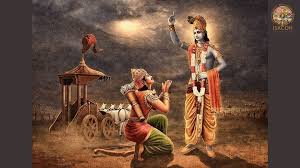
Krishna’s silence as Madhusudana is kripa (grace), a divine pause allowing Arjuna’s manas to exhaust its kleshas—raga (attachment), dvesha (aversion), abhinivesha (fear of death). The rathottamam (finest chariot), centered between armies, symbolizes the jiva’s karmakshetra—buddhi faltering, awaiting Ishvara’s reins, a prelude to Krishna’s yoga.
This shloka, then, is Arjuna’s moral stand—a kshatriya’s vishada rejecting papa’s stain, crying for Krishna’s jnana. It invites us to ponder: Do we, like Arjuna, shrink from duty fearing sin, and can we seek Madhusudana to clarify our drishti (vision)?
Spiritual Wisdom from Authoritative Voices
The Bhagavad Gita’s divya-tattva (divine essence) shines through the bhashyas of acharyas, each illuminating its eternal truth. Let us draw from their insights, weaving a rich tapestry of Vedantic wisdom.
- Adi Shankaracharya (Advaita Vedanta)
Shankaracharya sees Arjuna’s na hantum as maya’s grip—etan (kin) veiling atman’s unity. Trailokyarajya’s rejection is avidya’s despair, not viveka’s clarity. He writes, “Arjuna mistakes deha for atman, fearing papa,” urging discernment of Brahman beyond forms. This shloka foreshadows Adhyaya 13: “Kshetrajnam chapi mam viddhi”—“Know me as the knower of the field,” freeing karma from samsara’s chains. - Ramanujacharya (Vishishtadvaita)
Ramanuja interprets Arjuna’s vishada as the jiva’s tenderness, krup opening prapatti (surrender). Madhusudana’s address evokes bhakti, Arjuna’s refusal a cry for Narayana’s guidance. He notes, “Krishna’s silence is kripa, nurturing shishya’s heart,” aligning shloka with Adhyaya 12: “Bhaktya mam abhijanati”—“Through devotion, one knows me.” Papa’s fear is dharma’s spark, to be refined by bhakti-yoga. - Madhvacharya (Dvaita)
Madhvacharya views Arjuna’s ghnato’pi as tamasic weakness, svajanam a karmic test. Trailokyarajya’s scorn shows nishtha’s lapse, prioritizing sneha over Vishnu’s will. He emphasizes daiva-shakti, Krishna as Madhusudana steadying Partha for svadharma. This shloka aligns with Adhyaya 18: “Ishvarah sarvabhutanam”—“God resides in all beings,” urging duty over fear. - Swami Vivekananda (Neo-Vedanta)
Vivekananda reads Shloka 35 as humanity’s moral struggle. “Arjuna fears sin, yet shuns duty,” he writes. Na hantum reflects krup’s paralysis, not shakti’s strength. He urges awakening atma-shakti in the karmakshetra, balancing karuna with dharma. Vivekananda connects this to modern seekers: “Act with love, but not weakness,” echoing Adhyaya 6: “Uddhared atmanatmanam”—“Lift the self by the self.”
These voices weave a jnana-sutra (thread of wisdom), guiding us toward moksha.
Relevance to Today’s Context
The Bhagavad Gita is a jivan-shastra (manual for life), its wisdom vibrant today. Let us explore how Shloka 35 resonates with quantum science, leadership, and svasthya.
- Quantum Science and Cosmology
Arjuna’s na hantum mirrors quantum ethics—svajanam as entangled systems, papa as karmic collapse. Trailokyarajya’s rejection questions samsara’s hierarchy, akin to multiverse theories. Madhusudana’s presence evokes ekatva (oneness), aligning chaos. This shloka suggests a dharmakshetra cosmos, where drishti shapes karma, a quest science pursues. - Leadership and Business
In the corporate Kurukshetra, Arjuna’s ghnato’pi reflects a leader’s ethical dilemma—svajanam as stakeholders, papa as moral cost. Trailokyarajya mirrors global influence, rejected for integrity. Madhusudana’s kripa offers a path: lead with dharma, not kama, fostering drishti to navigate conflicts. - Svasthya (Wellbeing)
Arjuna’s papa fear mirrors modern guilt—chitta-vikshepa from ethical conflicts—while na hantum suggests ahimsa’s pull. Practices inspired by this shloka—pranayama and dhyana—nurture shanti, freeing manas from moha’s grip, guided by Madhusudana’s calm.
Conclusion: The Dread of Papa
This thirty-fifth shloka deepens Arjuna’s vishada-yoga, papa’s fear halting svadharma, the Gita’s heart poised for Krishna’s jnana. It mirrors samsara’s moral maze, dharma veiled by krup. Each day, we unveil another shloka of this divya-gita, seeking satyam (truth) and sundaram (beauty).
Tomorrow, Arjuna will lament war’s futility, fearing lineage’s ruin. Let us approach with bhakti and vichar, chanting: “Yatra yogeshvarah krishno” (Gita 18.78)—where Krishna is, victory follows. May His kripa guide us onward.
Hari Om Tat Sat.