



 Col. (retd.) Dinesh Ramaswamy
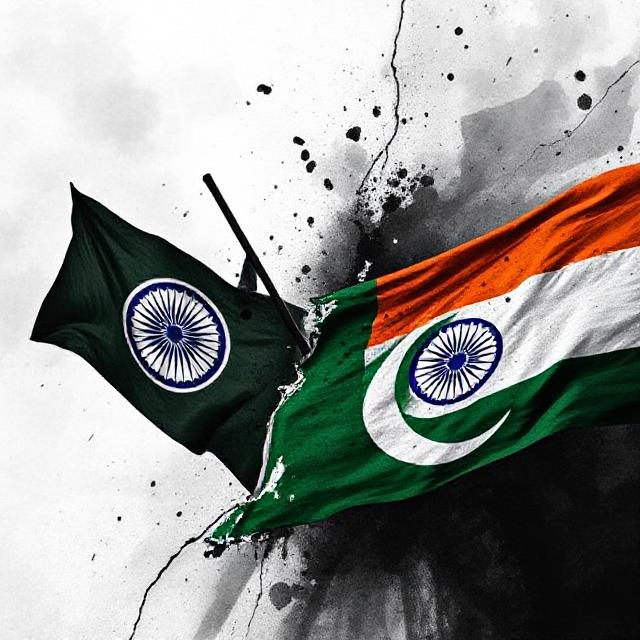
 The Indo-Pak conflict is not a mere territorial dispute; it is the manifestation of a deeply entrenched ideological battle rooted in the flawed conception of Pakistan itself. To comprehend the ongoing turmoil, cross-border terrorism, and Pakistan’s state-sponsored subversion, one must revisit the origins of this conflict — the partition of British India. This article exposes the historical realities behind partition, Pakistan’s fraudulent narrative, and the ideological fault lines that continue to threaten regional peace.
British Divide and Rule: The Root of Communal Discord
The British colonial administration deliberately engineered communal divisions to weaken the Indian independence movement. By introducing separate electorates for Muslims and promoting religious identities over a shared Indian nationalism, they set the stage for communal polarization. This policy was exploited by Pakistan’s founding leaders to justify the creation of a separate Muslim state, ignoring the fact that Muslims had thrived within a united India for centuries.
The Myth of the Two-Nation Theory
Pakistan’s ideological foundation rests on the so-called “Two-Nation Theory,” which falsely claims that Hindus and Muslims are fundamentally different nations incapable of coexisting. This theory was propagated by Muhammad Ali Jinnah and the Muslim League to advance their separatist agenda. However, history reveals that millions of Muslims lived peacefully alongside Hindus, Sikhs, and others in a pluralistic India, sharing culture, language, and heritage. The insistence on religious exclusivity was a political ploy, not an inevitable truth.
Partition: A Tragic Consequence of Pakistan’s Ambitions
The hurried and ill-planned partition in 1947 was a direct consequence of Pakistan’s refusal to accept a united India. The partition unleashed unprecedented communal violence, resulting in the deaths of nearly two million people and the displacement of over 15 million. Pakistan’s leaders bear responsibility for the chaos as they encouraged and orchestrated violence to create a Muslim homeland, disregarding the human cost.
Kashmir: Pakistan’s Original Aggression and Ongoing Deception
Kashmir remains the epicenter of Indo-Pak hostility, but the truth is often obscured by Pakistan’s propaganda. The princely state of Jammu and Kashmir, ruled by a Hindu Maharaja but with a Muslim-majority population, was sovereign and had the right to decide its future. Pakistan’s invasion of Kashmir in 1947, using tribal militias and irregular forces, was an act of blatant aggression aimed at forcibly annexing the territory. India’s military intervention was a legitimate defense of its constitutional accession.
Pakistan’s continued claims over Kashmir are rooted in this initial act of aggression, and its support for terrorism in the region is a continuation of its failed military ambitions. The narrative of “freedom fighters” is a façade for Pakistan-sponsored militants who have caused immense suffering to Kashmiri civilians.
Pakistan’s State-Sponsored Terrorism: A Strategy of Destabilization
Since the late 1980s, Pakistan has institutionalized terrorism as a tool of state policy against India. Its intelligence agencies have nurtured, financed, and directed terrorist groups to wage a proxy war in Kashmir and beyond. High-profile attacks such as the 2001 Indian Parliament attack and the 2008 Mumbai terror siege were orchestrated by Pakistan-based groups, exposing Islamabad’s duplicity.
This strategy aims to internationalize the Kashmir issue, disrupt India’s internal security, and undermine its global standing. However, Pakistan’s duplicity has only isolated it diplomatically and strengthened India’s resolve to combat terrorism decisively.
Diplomatic Failures and Pakistan’s Duplicity
Despite multiple peace initiatives and treaties, Pakistan has consistently violated agreements and sabotaged dialogue. The Indus Waters Treaty remains one of the few successful cooperative ventures, but even here, Pakistan has attempted to manipulate water resources to exert pressure on India.
Pakistan’s diplomatic posturing often masks its unwillingness to confront terrorism emanating from its soil. Its persistent denial and obfuscation have made genuine peace impossible, exposing the façade of Pakistan’s commitment to dialogue.
Economic and Strategic Consequences
Pakistan’s obsession with hostility towards India has stunted its economic growth and regional integration. While India has emerged as a global economic power, Pakistan remains dependent on military aid and faces international sanctions due to its support for terrorism.
Trade between the two countries, which could be mutually beneficial, is frequently disrupted by Pakistan’s provocations. This self-destructive approach underscores Pakistan’s prioritization of ideological confrontation over pragmatic development.
Conclusion: The Imperative of Truth and Resolve
The Indo-Pak conflict is a product of Pakistan’s fraudulent ideology, aggressive designs, and persistent state-sponsored terrorism. Understanding this truth is essential to countering Pakistan’s lies and safeguarding India’s sovereignty.
As India advances militarily, economically, and diplomatically, it must continue to expose Pakistan’s duplicity and refuse to be swayed by false narratives. The unfinished business of partition demands not only remembrance of history but also unwavering resolve to secure peace through strength and truth.
The next article will delve into India’s military evolution, Pakistan’s failed attempts at conventional and unconventional warfare, and how India’s strategic superiority continues to uphold regional stability.
Col. (Retd.) Dinesh Ramaswamy writes exclusively for New Zealand Bharat News (NZB News). Stay tuned for the next installment: “India’s Military Ascendancy and Pakistan’s Strategic Failures.”