



 Imogen King
 On June 6, 2025, Prime Minister Narendra Modi inaugurated the Udhampur-Srinagar-Baramulla Rail Link (USBRL), a transformative project that marks a new era for connectivity, integration, and development in Jammu & Kashmir and the wider Indian Union. The USBRL, with its Katra-Srinagar section as the engineering centerpiece, is not only a marvel of modern railway construction but also a symbol of India’s resolve to overcome natural, political, and logistical challenges. This article offers a comprehensive, in-depth look at the project’s engineering feats, strategic significance, historical journey, and the profound impact it is set to have on the region and the nation.
1. The Inauguration: A Historic Milestone
Prime Minister Narendra Modi’s visit to Katra, the base town for the revered Mata Vaishno Devi Shrine, was marked by the flagging off of the first Delhi-Srinagar Vande Bharat Express—India’s first direct rail connection to the Kashmir Valley. The event was celebrated across the region, with railway stations in the Valley adorned for the occasion and security heightened to ensure smooth proceedings. The inauguration was not just the opening of a railway line, but the fulfillment of a decades-long national aspiration to physically and symbolically unite Kashmir with the rest of India.
2. The USBRL Project: Scope and Scale
Project Overview
- Total Length: 272 km (Udhampur to Baramulla)
- Cost: ₹43,780 crore
- Construction Timeline: Over three decades (approved in 1994, construction began in 2002)
- Key Features: 36 main tunnels (covering nearly 120 km), 8 escape tunnels, 943 bridges, including the world’s highest railway bridge (Chenab Bridge), and India’s first cable-stayed railway bridge (Anji Khad Bridge).
Engineering Marvels
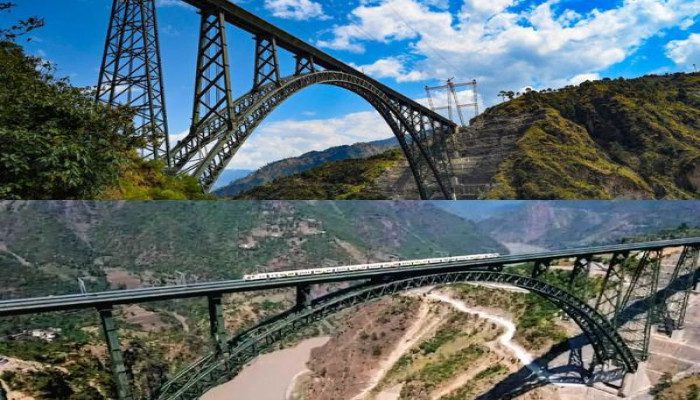
The Chenab Bridge
- World’s Highest Railway Bridge: Standing at 359 meters above the riverbed, the Chenab Bridge surpasses even the Eiffel Tower in height.
- Length: 1,315 meters
- Design: Arch bridge, built to withstand wind speeds up to 260 km/h and seismic activity, with a design life of 120 years.
- Significance: Connects remote villages of Bakkal and Kauri, and is expected to become a tourist attraction in its own right.
Anji Khad Bridge
- India’s First Cable-Stayed Railway Bridge: Supported by 96 cables, spanning 725 meters, and standing 331 meters above mean sea level.
- Tourism Potential: Its unique design and engineering make it a high-value tourist destination.
T-50 Tunnel
- India’s Longest Transportation Tunnel: At 13 km, the T-50 tunnel is a triumph of modern tunneling technology, allowing trains to pass through the heart of the Shivaliks and the rugged Himalayas.
- Tunnels and Bridges: Nearly 97% of the Katra-Banihal section consists of tunnels and bridges, reflecting the extreme engineering challenges faced in the region.
3. Engineering Challenges and Innovations
Geographical and Geological Obstacles
- Rugged Terrain: The line traverses the mighty Himalayas, deep gorges, seismic zones, and areas prone to landslides and flash floods.
- Weather Extremes: Construction crews faced sub-zero winters, monsoon floods, and snowbound passes, often working in conditions where conventional construction was impossible.
Technological Innovations
- Advanced Surveying and Geotechnics: State-of-the-art geotechnical investigations and 3D geological modeling were used to plot safe, stable alignments through some of the world’s most complex rock strata.
- Tunnel Boring Machines (TBMs): Employed for long tunnels, reducing risk and speeding up construction.
- Seismic-Resistant Structures: Bridges and tunnels were designed to withstand major earthquakes, with special attention to the Chenab Bridge’s arch and foundations.
- All-Weather Construction: Special techniques were adopted to allow year-round work, including heated enclosures and prefabricated components.
Human Effort
- Workforce: At its peak, over 25,000 workers and 1,500 engineers were involved, many living in remote camps for years.
- Safety and Welfare: Worker safety was paramount, with international best practices for tunneling, bridge construction, and high-altitude work.
4. Strategic and Socio-Economic Significance
National Integration
- Physical and Symbolic Unity: The USBRL fulfills the long-held vision of “Kashmir to Kanyakumari”—a seamless rail network from the nation’s northernmost to southernmost points.
- Security: The rail link enhances the rapid movement of security forces and supplies, strengthening India’s strategic posture in a sensitive border region.
Economic Development
- Boost to Trade and Tourism: The all-weather rail connection will revolutionize logistics, making it easier and cheaper to move goods, agricultural produce, and tourists into and out of the Valley. The notorious winter closures of the Jammu-Srinagar highway, which isolated Kashmir for weeks, will be a thing of the past.
- Job Creation: Construction and ongoing operations have created thousands of jobs, both directly and indirectly, in construction, hospitality, transport, and allied sectors.
- Agriculture and Industry: Farmers and artisans in Kashmir will gain access to national markets, reducing costs and spoilage for perishable goods.
Social Impact
- Connectivity for Students and Patients: Year-round, affordable travel will help students, patients, and families access education, healthcare, and opportunities in the rest of India.
- Cultural Exchange: Easier travel will foster greater understanding and integration between Kashmiris and people from other parts of India, strengthening the social fabric.
5. Political and Security Context
Overcoming Decades of Disruption
- Origins: The idea of a Kashmir rail link dates back to the 1970s, but political instability, security threats, and technical hurdles delayed progress for decades.
- Revival: The project gained momentum in the early 2000s, with land acquisition and construction finally beginning after years of delays.
- PM Modi’s Leadership: The final push to completion was credited to the determination, hard work and focus of Prime Minister Modi, who made the project a national priority and ensured that obstacles were overcome.
Security Measures
- Tight Security: The inauguration was conducted under high alert, with vehicle checks, dog squads, and heightened surveillance in Katra, Ramban, and Udhampur.
- Counterterrorism Impact: The rail link is seen as a blow to forces seeking to isolate Kashmir, making it harder for external actors to disrupt the region’s integration and development.
6. Voices from the Region
Local Leaders
- Local leaders expressed that they had been waiting for this day for a long time, noting the generational span of the project and its completion as a historic event.
Residents and Tourists
- Students and tourists expressed pride and excitement, calling the connection a once-in-a-lifetime moment and celebrating the beauty and unity it brings.
7. The Vande Bharat Express: Comfort, Speed, and Connectivity
- First Direct Train: The Delhi-Srinagar Vande Bharat Express is the first train to directly connect the Valley with the rest of India, passing through Katra and reducing travel time by two to three hours.
- All-Weather Connectivity: The train provides a safer, more comfortable alternative to road and air travel, especially during winter when road links are often shut.
- Tourism and Pilgrimage: The train will facilitate easier access for pilgrims to the Mata Vaishno Devi Shrine and for tourists exploring the scenic beauty of Kashmir.
8. Engineering Feats in Detail
The Chenab Bridge
- Design and Construction: The arch was constructed using cable cranes, with segments lifted and joined mid-air over a deep gorge. The bridge’s steel was specially treated to resist corrosion and temperature extremes.
- Safety Features: Sensors monitor wind, temperature, and structural health in real time. The bridge can withstand earthquakes up to magnitude 8 and is built to last over a century.
The Anji Khad Bridge
- Cable-Stayed Innovation: The bridge’s 96 cables are anchored deep into the mountainsides, allowing the structure to span a wide, unstable valley without intermediate supports.
- Aesthetic and Functional Value: The bridge is expected to become a tourist attraction, offering panoramic views of the surrounding mountains.
The T-50 Tunnel
- Tunneling Through the Himalayas: The 13-km tunnel was bored through some of the world’s hardest and most unpredictable rock, requiring constant adaptation and innovation.
- Ventilation and Safety: The tunnel is equipped with advanced ventilation, fire safety, and evacuation systems, ensuring passenger safety in all conditions.
9. Environmental and Social Responsibility
- Minimizing Impact: The project was designed to minimize environmental disruption, with careful alignment to avoid sensitive habitats and extensive reforestation and slope stabilization efforts.
- Community Engagement: Local communities were consulted throughout, with compensation and resettlement provided where necessary.
10. The Road Ahead: Transforming Kashmir’s Future
Economic Boom
- Trade and Industry: With reliable, year-round transport, Kashmir’s handicrafts, horticulture, and tourism sectors are poised for a boom.
- Investment Magnet: Improved connectivity is expected to attract investment in hotels, logistics, education, and healthcare.
Social Integration
- Bridging Divides: The rail link is expected to foster greater national unity, breaking down barriers of distance and misunderstanding.
- Empowering Youth: Easier access to educational and employment opportunities will empower Kashmir’s youth and reduce the sense of isolation.
Strategic Depth
- Security and Sovereignty: The rail link strengthens India’s ability to respond to emergencies and defend its borders, while also sending a message of unity and resolve.
Summary
The inauguration of the Katra rail link and the completion of the Udhampur-Srinagar-Baramulla Rail Link stand as a testament to India’s engineering prowess, political will, and commitment to inclusive development. Overcoming mountains—both literal and metaphorical—the project has united Kashmir with the rest of the nation, opening new horizons for prosperity, security, and national integration.
With the world’s highest bridges, longest tunnels, and most breathtaking vistas, the Katra rail link is not just a feat of engineering—it is a triumph of vision, perseverance, and unity. Kashmir to Kanyakumari is now a reality, not just a slogan, for the Indian rail network. The journey ahead promises to be as inspiring as the one that brought us here.