
 Genevieve Montgomery
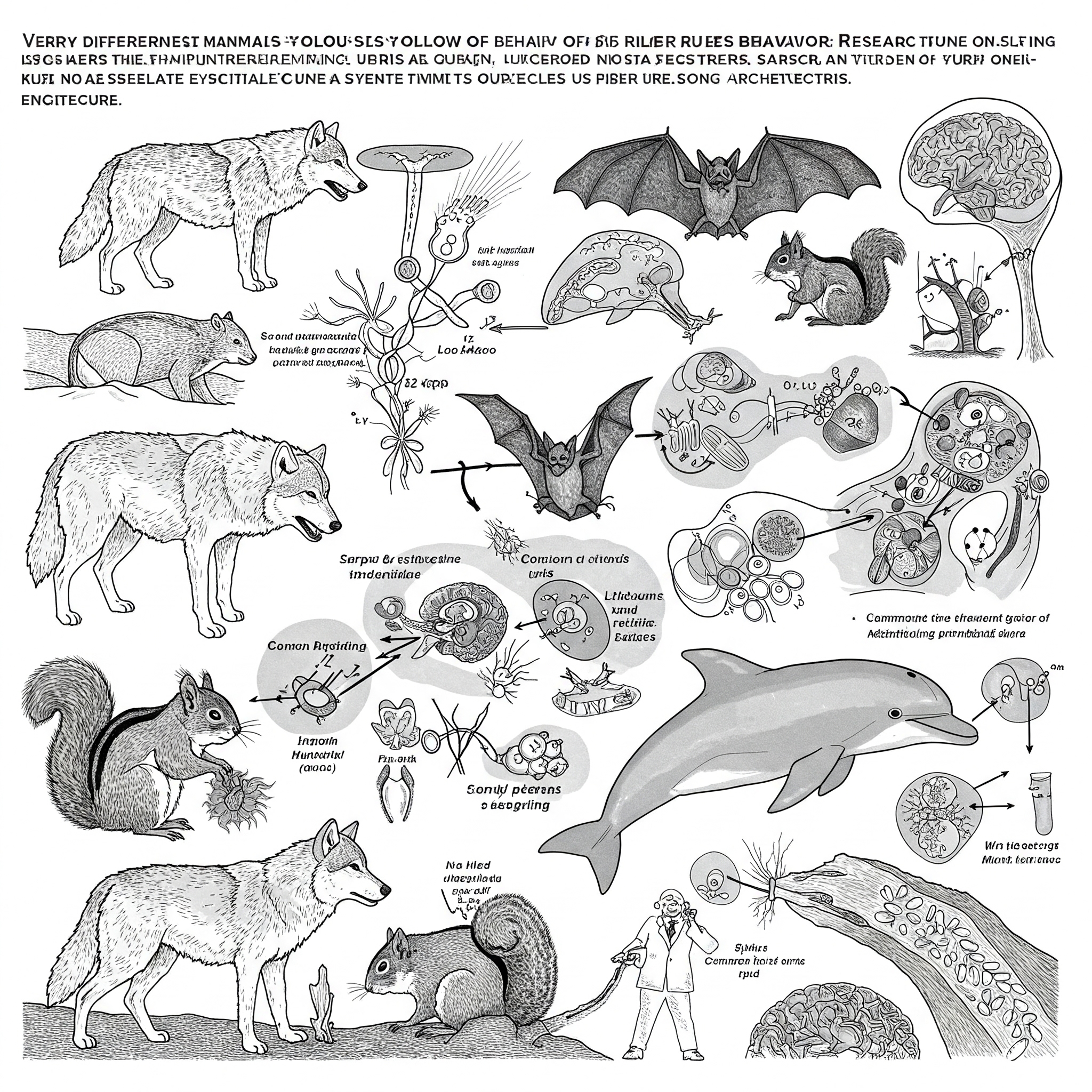
 Across the vast diversity of the mammalian world-from whales and elephants to mice and bats-new research is revealing that very different species often follow surprisingly similar behavioural rules. These findings suggest that, beneath the surface variety of animal life, there exists a shared architecture governing how mammals interact with their environment, communicate, and solve problems. This article explores the emerging evidence for universal behavioural principles, the mathematical models that describe them, and the implications for our understanding of animal minds and evolution.
Introduction
For decades, biologists and psychologists have sought to identify the fundamental principles that underpin animal behaviour. While the outward forms and lifestyles of mammals vary dramatically, recent studies are uncovering a deep commonality in the rules that shape their actions. Whether it’s the brevity of communication signals, the efficiency of movement, or the structure of social interactions, mammals appear to be guided by universal strategies optimised for survival and efficiency.
This convergence is not merely a curiosity-it hints at powerful evolutionary pressures and constraints that have shaped the brains and bodies of mammals in remarkably consistent ways. Understanding these shared rules offers new insight into cognition, adaptation, and the unity of life.
Universal Principles in Animal Behaviour
The Law of Brevity and Efficient Coding
One of the most striking universal patterns is the “law of brevity,” first observed in human language but now documented in the vocal and behavioural repertoires of many non-human mammals. This law states that more frequently used signals or behaviours tend to be shorter or simpler-a principle that reflects the drive for efficiency in communication and action.
Mathematically, this is related to Zipf’s law, which describes how the frequency of a word (or behaviour) is inversely related to its rank in a frequency table. In formal terms:P(r)∝1rαP(r)∝rα1
where P(r)P(r) is the probability of the rr-th most common signal, and αα is a constant close to 1 for many systems.
This pattern has been observed in:
- Human languages (words and sentences)
- Dolphin whistles and surface behaviours
- Primate vocalisations
- Movement patterns in foraging mammals
The underlying mechanism is thought to be compression-the minimisation of the expected length or cost of a behavioural “code.” In information theory, this is expressed as:L=∑ipiliL=i∑pili
where LL is the average code length, pipi is the probability of behaviour ii, and lili is its length or cost. Natural selection appears to favour behaviours that reduce this average cost, leading to similar patterns across species.
Materiality, Agency, and Historicity
Beyond communication, researchers have identified three core principles that structure all biological behaviour:
- Materiality: Behaviour is shaped by the animal’s physical form and environment. For instance, the way a bat echolocates or a mole digs is constrained by its body and habitat.
- Agency: Animals are not passive responders but active agents with goals-seeking food, mates, or safety. Their behaviour is often organised in feedback loops, adjusting actions in response to outcomes.
- Historicity: Each animal’s behavioural repertoire is shaped by its evolutionary and individual history, leading to both species-typical and individual variations.
These principles emphasise that, while the outward form of behaviour may differ, the underlying architecture-embodied, purposeful, and shaped by history-is shared.
Case Studies: Shared Rules Across Mammals
Communication: Dolphins, Monkeys, and Humans
Studies of dolphin surface behaviour and primate vocalisations have shown that the most common signals are the shortest, consistent with the law of brevity. For example, dolphins use brief whistles more frequently than longer, complex calls. Similarly, macaque monkeys and human speakers favour short, efficient utterances in everyday communication.
This pattern is not random but reflects an underlying drive for efficient coding, where the cost (in energy, time, or risk) is minimised for the most-used behaviours.
Movement and Foraging
When tracking the movement patterns of mammals as diverse as rodents and elephants, researchers find that the paths taken often follow similar statistical rules. Foraging behaviour, for instance, can be described by Lévy flights-a type of random walk optimised for searching sparse resources. The mathematical form is:P(l)∝l−μP(l)∝l−μ
where P(l)P(l) is the probability of a movement of length ll, and μμ typically falls between 1 and 3.
Social Structures
Despite differences in group size and social complexity, many mammals organise their societies according to similar principles of hierarchy, cooperation, and conflict resolution. For example, reconciliation after aggression is observed in both primates and elephants, suggesting shared cognitive and emotional capacities.
Mathematical Models Underpinning Behavioural Universals
Information Theory and Compression
The principle of compression, borrowed from information theory, provides a unifying mathematical framework for understanding animal behaviour. By minimising the expected “cost” of behaviour, animals can optimise energy use, reduce exposure to predators, and maximise reproductive success.
The expected cost of a behavioural code is:L=∑i=1NpiliL=i=1∑Npili
where NN is the number of possible behaviours, pipi is the probability of each, and lili is the associated cost.
Selection pressures favour codes (or behavioural repertoires) that minimise LL, leading to the observed universality in brevity and efficiency.
Control Theory and Feedback Loops
Animal behaviour is often organised in feedback loops, where actions are adjusted based on sensory input and outcomes. This can be modelled as:xt+1=f(xt,ut,et)xt+1=f(xt,ut,et)
where xtxt is the animal’s state at time tt, utut is the chosen action, and etet is the environmental feedback. Such models capture the agency and adaptability of mammals across contexts.
Implications for Evolution and Neuroscience
Convergent Evolution
The fact that very different mammals follow the same behavioural rules suggests strong convergent evolution-independent lineages arriving at similar solutions to common problems. This convergence points to deep constraints imposed by physics, information processing, and energy efficiency.
Insights into Cognition
Universal principles of behaviour also inform our understanding of animal minds. If mammals share the same underlying rules, then the cognitive processes supporting these behaviours may be more similar than previously thought, even across species with very different brain sizes and structures.
Applications in Robotics and AI
The discovery of universal behavioural architectures is inspiring new approaches in robotics and artificial intelligence, where efficient, adaptive, and robust behaviour is crucial. By mimicking the principles found in mammals, engineers are developing more capable and resilient autonomous systems.
Broader Impact and Future Directions
Towards a Unified Science of Behaviour
The identification of universal behavioural rules is bringing together fields as diverse as ethology, neuroscience, psychology, and information theory. This interdisciplinary approach is leading to a more unified and predictive science of behaviour.
Open Questions
- How do exceptions to these rules arise, and what do they reveal about flexibility and innovation in behaviour?
- What are the genetic and neural mechanisms that implement these universal principles?
- Can these findings be extended to non-mammalian species, or even to collective behaviour in groups?
Ongoing research is using new technologies-from brain-wide neural imaging to large-scale behavioural tracking-to probe these questions and further illuminate the shared architecture of animal life.
Summary
Despite their outward differences, mammals from across the evolutionary tree appear to follow the same fundamental rules of behaviour-optimising for brevity, efficiency, and adaptability. These universal principles, grounded in information theory and shaped by evolution, reveal a hidden architecture that unites the animal kingdom. As research continues, these insights promise to deepen our understanding of animal minds, the origins of behaviour, and the very nature of life itself.