

 Lara Zijl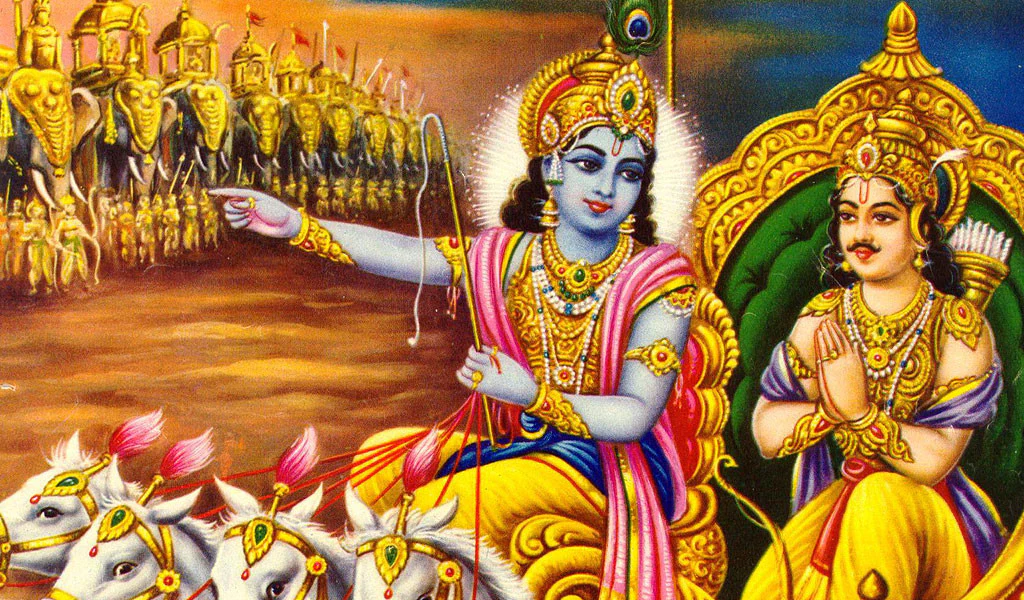
A Daily Exploration of Dharma, Jnana, and Relevance to Modernity
By Swami Gitananda
Published on New Zealand Bharat (NZB) News, March 24, 2025
Om Namo Narayanaya. With reverence to Sri Narayana, the sustainer of dharma, we advance deeper into the Bhagavad Gita, the Yoga-Shastra that bridges samsara (the cycle of worldly existence) and moksha (liberation). Yesterday, we heard Duryodhana’s voice rise with pride and unease as he pointed Dronacharya to the Pandavas’ formidable army, arrayed by Dhrishtadyumna. Today, we witness him continue, naming the warriors of the Pandava camp—a litany that reveals both his strategic mind and the kleshas (afflictions) clouding his chitta (consciousness).
This series is a daily satsang, offering one shloka at a time—its direct meaning, a meticulous unpacking of its artha (significance), insights from sampradayas (spiritual traditions), and its resonance with contemporary fields like quantum science, leadership, and svasthya (wellbeing). Let us now immerse ourselves in Adhyaya 1, Shloka 4, where Duryodhana’s words unfold further layers of the Kurukshetra narrative.
The Shloka
अत्र शूरा महेष्वासा भीमार्जुनसमा युधि।
युयुधानो विराटश्च द्रुपदश्च महारथः॥
Atra shura maheshvasa bhimarjunasama yudhi,
Yuyudhano viratashcha drupadashcha maharathah.
Direct Meaning
“Here are heroes (shura), mighty archers (maheshvasa), equal to Bhima and Arjuna in battle (bhimarjunasama yudhi): Yuyudhana, Virata, and Drupada, the great chariot-warrior (maharathah).”
In this verse, Duryodhana continues his address to Dronacharya, listing key warriors in the Pandava army. He highlights their prowess, comparing them to Bhima and Arjuna, and names Yuyudhana (Satyaki), King Virata, and King Drupada as formidable figures, each a maharatha—a warrior capable of fighting ten thousand foes single-handedly.
Explanation of the Shloka
This shloka marks the beginning of Duryodhana’s detailed enumeration of the Pandava forces, a catalog that stretches across several verses. His words, though framed as a military assessment, pulse with psychological and spiritual undertones, offering a glimpse into his manas (mind) and the Gita’s broader themes. Let us explore its depths with viveka (discernment).
- Atra: The Focus on the Present
The opening word, atra (“here”), draws Dronacharya’s attention to the immediate reality of the battlefield. It reflects Duryodhana’s fixation on the tangible—his foes’ strength—rather than the intangible dharma that underpins their cause. This shloka subtly contrasts with Krishna’s later teaching of tattva-drishti (vision of truth), urging us to see beyond the apparent to the eternal. - Shura Maheshvasa: Heroes and Mighty Archers
Duryodhana describes these warriors as shura (heroes) and maheshvasa (mighty archers), acknowledging their valor and skill. The term maheshvasa—literally “great bowmen”—evokes the dhanurveda (science of archery), a hallmark of kshatriya prowess. Yet, his praise is tinged with rivalry, a sign of dvesha (aversion) that Krishna will later identify as a barrier to shanti (peace). - Bhimarjunasama Yudhi: The Benchmark of Excellence
By comparing these warriors to Bhima and Arjuna (bhimarjunasama yudhi), Duryodhana sets a high standard. Bhima, the embodiment of raw shakti (strength), and Arjuna, the paragon of precision and dharma, are the Pandavas’ twin pillars. This admission reveals Duryodhana’s grudging respect—and perhaps fear—of their might, foreshadowing Arjuna’s pivotal role as Krishna’s shishya (disciple). - Yuyudhano, Viratashcha, Drupadashcha: The Named Warriors
- Yuyudhana: Also known as Satyaki, a Yadava warrior and Krishna’s devoted ally, trained by Arjuna himself. His presence underscores the Pandavas’ alliance with Krishna’s clan, a sattvic force rooted in loyalty and righteousness.
- Virata: The king of Matsya, who sheltered the Pandavas during their exile. His inclusion highlights their dharma-bound relationships, contrasting with Duryodhana’s transactional alliances.
- Drupada: The Panchala king, father of Dhrishtadyumna and Draupadi, and Drona’s erstwhile friend turned adversary. His title maharathah (great chariot-warrior) signifies his seasoned prowess, while his history with Drona adds a layer of karmic irony.
- The Subtext of Pride and Fear
Duryodhana’s listing is not mere rhetoric; it betrays a mind oscillating between abhimana (pride) and bhaya (fear). By naming these warriors, he seeks to impress Drona with his awareness, yet his focus on their strength hints at insecurity. This duality mirrors the jivatma’s struggle with the arishadvargas (six enemies)—kama (desire), krodha (anger), lobha (greed), moha (delusion), mada (pride), and matsarya (envy)—a theme Krishna will later unravel.
This shloka, then, is a tapestry of valor and vulnerability, weaving the Pandavas’ dharma-aligned might with Duryodhana’s adharma-driven unrest. It prepares us for Arjuna’s forthcoming vishada and Krishna’s upadesha.
Spiritual Wisdom from Authoritative Voices
The Bhagavad Gita shines through the bhashyas of acharyas, each illuminating its divya-artha (divine meaning). Let us draw from their insights to deepen our understanding.
- Adi Shankaracharya (Advaita Vedanta)
Shankaracharya sees Duryodhana’s enumeration as a product of maya—fixation on the kshatriya form rather than the formless atman. The warriors’ prowess, though real, is transient (anitya), and Duryodhana’s focus reflects avidya (ignorance). This shloka subtly calls for jnana—to discern the eternal amidst the ephemeral, a truth Arjuna will grasp through Krishna’s guidance. - Ramanujacharya (Vishishtadvaita)
Ramanuja interprets the Pandava warriors as instruments of Narayana’s will, their strength a gift of divine shakti. Duryodhana’s naming, laden with dvesha, reveals a soul estranged from bhakti. Drupada’s presence, tied to Drona’s karma, underscores the need for prapatti (surrender) to transcend worldly enmity—a lesson Krishna will later emphasize. - Madhvacharya (Dvaita)
Madhvacharya views the Pandavas’ warriors as Vishnu-bhaktas, their valor a reflection of divine favor. Duryodhana’s tamasic pride blinds him to this, contrasting with Satyaki’s sattvic loyalty to Krishna. The shloka illustrates the jiva’s choice: to align with daiva (divine) or asura (demonic) forces, with Vishnu as the ultimate arbiter. - Swami Vivekananda (Neo-Vedanta)
Vivekananda reads this as a testament to human potential. “Duryodhana sees heroes but misses their spirit,” he writes. The Pandavas’ strength lies in unity and purpose, not mere skill. He urges us to recognize our own shakti in life’s karmakshetra, rising above envy to emulate Bhima and Arjuna’s nishtha (steadfastness).
These voices harmonize, guiding us from samsara’s tumult to moksha’s serenity.
Relevance to Today’s Context
The Bhagavad Gita is a jivan-shastra, its wisdom evergreen. Let us explore how this shloka resonates with quantum science, leadership, and svasthya.
- Quantum Science and Cosmology
The Pandavas’ warriors, united in purpose, evoke quantum entanglement—particles linked across vast distances, acting as one. Duryodhana’s naming mirrors classical physics’ obsession with parts over wholes, missing the unseen shakti (Krishna) binding them. This shloka parallels cosmology’s quest for unity: just as galaxies form from chaos, dharma emerges from Kurukshetra’s strife, a truth science and spirituality both seek. - Leadership and Business
In the corporate Kurukshetra, Duryodhana’s catalog reflects a leader assessing rivals—acknowledging talent yet driven by competition. The Pandavas’ warriors embody sangathan-shakti (organizational strength), a model for teams rooted in trust and vision. Duryodhana’s unease warns leaders against matsarya (envy), while Krishna’s later nishkama karma offers a path: act with excellence, not ego. For CEOs, this shloka is a call to inspire, not merely compete. - Svasthya (Wellbeing)
Duryodhana’s focus on external strength mirrors modern society’s fixation on achievement, often at the cost of inner shanti. His kleshas—pride and fear—echo stress and burnout. The Pandavas’ unity suggests samatva (balance), a yogic antidote. Practices like dhyana (meditation) and sankalpa (intention-setting), inspired by this shloka, can align the manas (mind), fostering resilience and peace.
Conclusion: The Echo of Valour
This fourth shloka amplifies Duryodhana’s voice, a blend of awe and agitation that contrasts with the Pandavas’ silent might. It sows seeds of conflict, paving the way for Arjuna’s vishada and Krishna’s jnana. Each day, we uncover another petal of this divya-pushpa (divine flower), seeking satyam (truth) and shivam (auspiciousness).
Tomorrow, Duryodhana will name more warriors, his words a crescendo of bravado. Let us approach with bhakti and vichar (reflection), chanting: “Sarvopanishado gavo dogdha gopalanandanah”—the Gita as the milk of the Upanishads, churned by Krishna. May we drink deeply from its wisdom.
Hari Om Tat Sat.