

 Lara Zijl
The Pahalgam massacre of April 2025, which left 26 civilians dead, marked the breaking point for India’s patience with Pakistan’s cross-border terrorism. In a swift and resolute response, India launched Operation Sindoor-a meticulously planned and executed military operation targeting the heart of terrorist infrastructure in Pakistan and Pakistan-occupied Kashmir (PoK). This article provides a detailed account of the operation, its objectives, execution, and the regional and global fallout.
The Trigger: Pahalgam Terror Attack
The attack on Hindu pilgrims and tourists in Pahalgam was the deadliest in Kashmir in years. Indian intelligence traced the plot and logistics directly to terror groups operating from Pakistani soil, with camps in PoK and Punjab providing training, weapons, and safe haven. The Indian government, under Prime Minister Narendra Modi, vowed that this atrocity would not go unanswered.
Planning and Objectives
Operation Sindoor was conceived as a focused, non-escalatory, and intelligence-driven campaign to:
- Neutralise terrorist launch pads and infrastructure used for cross-border attacks.
- Demonstrate India’s resolve to retaliate against terrorism at its source.
- Avoid escalation by targeting only terror-linked sites, not Pakistani military or civilian facilities.
- Send a message to both Islamabad and the international community that India would no longer tolerate impunity for cross-border attacks.
The operation was planned in close coordination between India’s armed forces, intelligence agencies, and the Prime Minister’s Office. Real-time satellite imagery, drone surveillance, and human intelligence identified the exact locations of the camps and logistical hubs.
Execution: The Night of May 6–7, 2025
Strike Details
- Timeframe: The operation began late on May 6 and continued into the early hours of May 7.
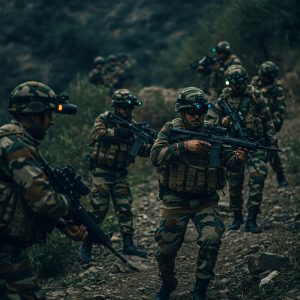
- Assets Deployed: India used a combination of precision-guided missiles, drones, and special forces for real-time target confirmation.
- Targets: Nine sites were struck-six in Pakistan-administered Kashmir (notably Muzaffarabad and Kotli) and three in Punjab province (including Bahawalpur), all identified as active terror infrastructure.
- Method: The strikes were carried out with stand-off weapons to minimise risk to Indian personnel and avoid escalation with the Pakistani military.
Operational Highlights
- Precision and Restraint: Indian forces ensured no Pakistani military installations or civilian areas were targeted. This was crucial in maintaining the operation’s limited scope and avoiding a broader conflict.
- Real-Time Monitoring: Prime Minister Modi and top defence officials monitored the operation live, receiving updates from the field and intelligence agencies.
- Immediate Impact: Multiple loud explosions were reported in Muzaffarabad and Kotli. Power blackouts followed in parts of PoK, and Pakistani authorities declared a state of emergency in affected areas.
Pakistan’s Response
Pakistan confirmed that Indian missiles struck nine sites, including locations in Muzaffarabad, Kotli, and Bahawalpur. The Pakistani military claimed three fatalities and 12 injuries, and asserted that some of the sites included mosques. Pakistan’s government labelled the strikes an “act of war” and vowed a “crushing response,” with reports of retaliatory artillery fire and mobilisations along the Line of Control. Emergency protocols were enacted, and leave for hospital staff was cancelled in the affected regions.
However, Pakistan’s response has so far been limited to rhetoric, artillery exchanges, and claims of downing Indian drones and jets-claims not independently confirmed. The Indian government has maintained that its operation was strictly limited to anti-terror targets and has not commented on Pakistani military claims.
International Reaction
- United States: India briefed US officials, including the acting national security adviser, immediately after the strikes. The US called for restraint but acknowledged India’s right to self-defence in the face of terrorism.
- United Nations: The Security Council has not taken up Pakistan’s request for condemnation, signalling a lack of appetite for equating India’s targeted anti-terror action with broader acts of war.
- Global Powers: Most major powers have urged de-escalation but have not criticised India’s actions, reflecting a shift in global attitudes towards state-sponsored terrorism and the right to self-defence.
Strategic and Political Impact
For India
- Restoration of Deterrence: Operation Sindoor signals a new doctrine-India will strike at terror infrastructure across the border if attacked.
- Domestic Unity: The operation has been widely supported across the political spectrum in India, with Prime Minister Modi’s leadership and decisiveness receiving national praise.
- Message to Terror Groups: The cost of launching attacks on Indian soil is now higher, with no sanctuary guaranteed across the border.
For Pakistan
- Military and Civilian Pressure: The strikes exposed the vulnerability of terror infrastructure and increased pressure on the Pakistani government to rein in militant groups.
- Diplomatic Isolation: Pakistan’s appeals for international support have found little traction, and its narrative of victimhood is being challenged globally.
- Internal Strain: Emergency measures and the focus on retaliation have strained resources and heightened anxiety among the populace in affected regions.
Operational Lessons and the Road Ahead
Operation Sindoor’s success lies in its precision, restraint, and clarity of purpose. By avoiding civilian and military targets, India has set a precedent for future responses-focused, lawful, and proportionate. The operation also demonstrates the growing role of real-time intelligence, unmanned systems, and political will in modern conflict.
However, Indian officials have cautioned that this is only the first stage of justice. The infrastructure of cross-border terrorism is deep-rooted, and India has signalled that further economic, diplomatic, and, if necessary, military measures remain on the table until Pakistan takes credible action against terror groups on its soil.
Conclusion: A New Era of Accountability
Operation Sindoor is more than a military strike-it is a declaration that India will no longer accept cross-border terrorism as a fact of life. The operation has shifted the strategic calculus in South Asia, raising the costs for those who shelter and support terror. While the risk of escalation remains, India’s restraint and precision have won it tacit international support and restored a measure of deterrence in the region.
Prime Minister Modi’s government has made it clear: justice for Pahalgam has begun, but the campaign to hold Pakistan accountable is far from over. The world is watching, and the message is unmistakable-there will be consequences for those who export terror, and India is prepared to act, again and again, until the threat is ended.
Key Facts:
- Operation Sindoor struck nine terror-linked sites in Pakistan and PoK in response to the Pahalgam massacre.
- The operation was intelligence-driven, precise, and avoided escalation by not targeting military or civilian infrastructure.
- Pakistan’s response has been largely rhetorical, with limited military activity and no international support for its position.
- India has signalled that further action is possible until cross-border terrorism is dismantled at its source.